
132 Lawmakers Ask HHS to Review Planned Parenthood’s Federal Funding Compliance
October 7, 2026
A congressional letter signed by 132 lawmakers asks the HHS inspector general to examine Planned Parenthood’s federal funding streams, grant compliance, and possible program-integrity violations. Baptist Press reported the request October 7, including support from the Southern Baptist ERLC. The development matters to Christians following pro-life policy, taxpayer accountability, and the difference between requesting an investigation and establishing wrongdoing.
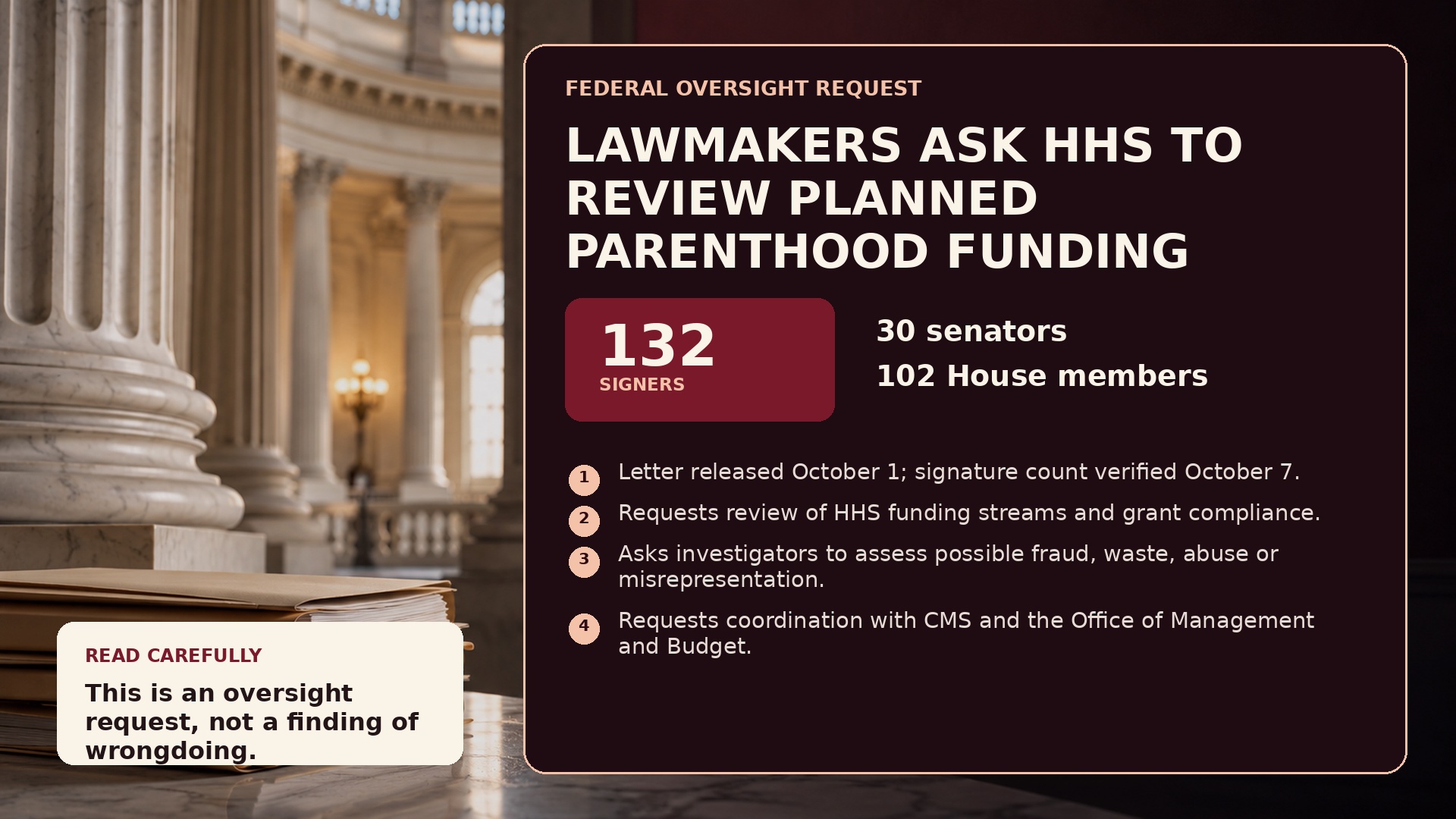
A letter released October 1, 2026, and addressed to the inspector general of the U.S. Department of Health and Human Services asks for an investigation of Planned Parenthood Federation of America and its affiliates regarding their receipt and use of federal funds. Baptist Press, in a report republished by the Biblical Recorder on October 7, stated that the letter had 132 congressional signatures as of 10:30 a.m. Central that day: 30 senators and 102 members of the House of Representatives. The effort was led by Senator James Lankford of Oklahoma and Representative Chris Smith of New Jersey. The signers asked the inspector general to review federal funding streams flowing through HHS programs, grants, contracts, or subawards; assess compliance with relevant legal, regulatory, and grant conditions; determine whether evidence exists of fraud, waste, abuse, misrepresentation, or other violations affecting federal health programs; and evaluate possible administrative remedies or referrals if misconduct is identified. They also requested coordination with components inside HHS, including the Centers for Medicare & Medicaid Services, as well as the Office of Management and Budget. The report noted that the congressional letter referenced a separate Small Business Administration inquiry involving loans received by Planned Parenthood affiliates during the COVID-19 period. Evan Lenow, president of the Southern Baptist Ethics & Religious Liberty Commission, supported the oversight request in a statement to Baptist Press and argued that taxpayers should not be implicated in practices that conflict with pro-life convictions. The verified development is the request for review and its stated scope. It is not itself an inspector general finding, a criminal charge, or proof that any allegation in the lawmakers’ letter has been established.
For Bible-centered Christians, the story brings together two responsibilities that should be kept distinct but pursued with equal care: defending vulnerable human life and speaking truthfully about public allegations. The congressional request is nationally significant because it concerns federal money, nationwide affiliates, and oversight standards that apply across multiple HHS programs. It also shows how pro-life advocacy operates through more than elections or public demonstrations. Lawmakers can seek audits, examine grant conditions, request interagency coordination, and ask enforcement officials to determine whether public funds have been handled according to law. Churches and individual believers following the issue should read the letter and the reporting with precision. The lawmakers identify areas they believe warrant investigation, while the inspector general remains responsible for examining records, assessing compliance, and determining whether evidence supports any remedy. That procedural distinction protects credibility and avoids turning serious claims into conclusions before the evidence is tested. Christian engagement is strongest when concern for unborn children and their mothers is matched by a commitment to due process, accurate language, compassionate service, and responsible stewardship. Congregations can respond constructively by learning how federal funding rules work, supporting pregnancy-resource ministries that offer material and relational care, helping families facing difficult pregnancies, and encouraging elected officials to pursue transparent oversight. The four requests in the letter provide a clear framework for watching what happens next: identify the funding streams, test compliance, assess evidence of program violations, and determine whether enforcement is warranted. Until an official review produces findings, the most responsible summary remains straightforward: a large group of federal lawmakers has asked HHS oversight officials to investigate, and a Southern Baptist public-policy leader has endorsed that request from a pro-life and taxpayer-accountability perspective.
Pro-Life Public Policy and Federal Funding Oversight
Evangelical Protestant — Southern Baptist
Christians, church leaders, pro-life advocates, policy professionals, and voters
Biblical Recorder / Baptist Press

Why Pro-Life?: Caring for the Unborn and Their Mothers
Randy Alcorn
Randy Alcorn’s completely revised 2012 Hendrickson edition explains a Christian pro-life case while emphasizing care for both unborn children and their mothers, fitting the policy and pastoral questions raised by this oversight story.