
9th Circuit Rehears Christian Ministry’s Faith-Based Hiring Case
September 28, 2026
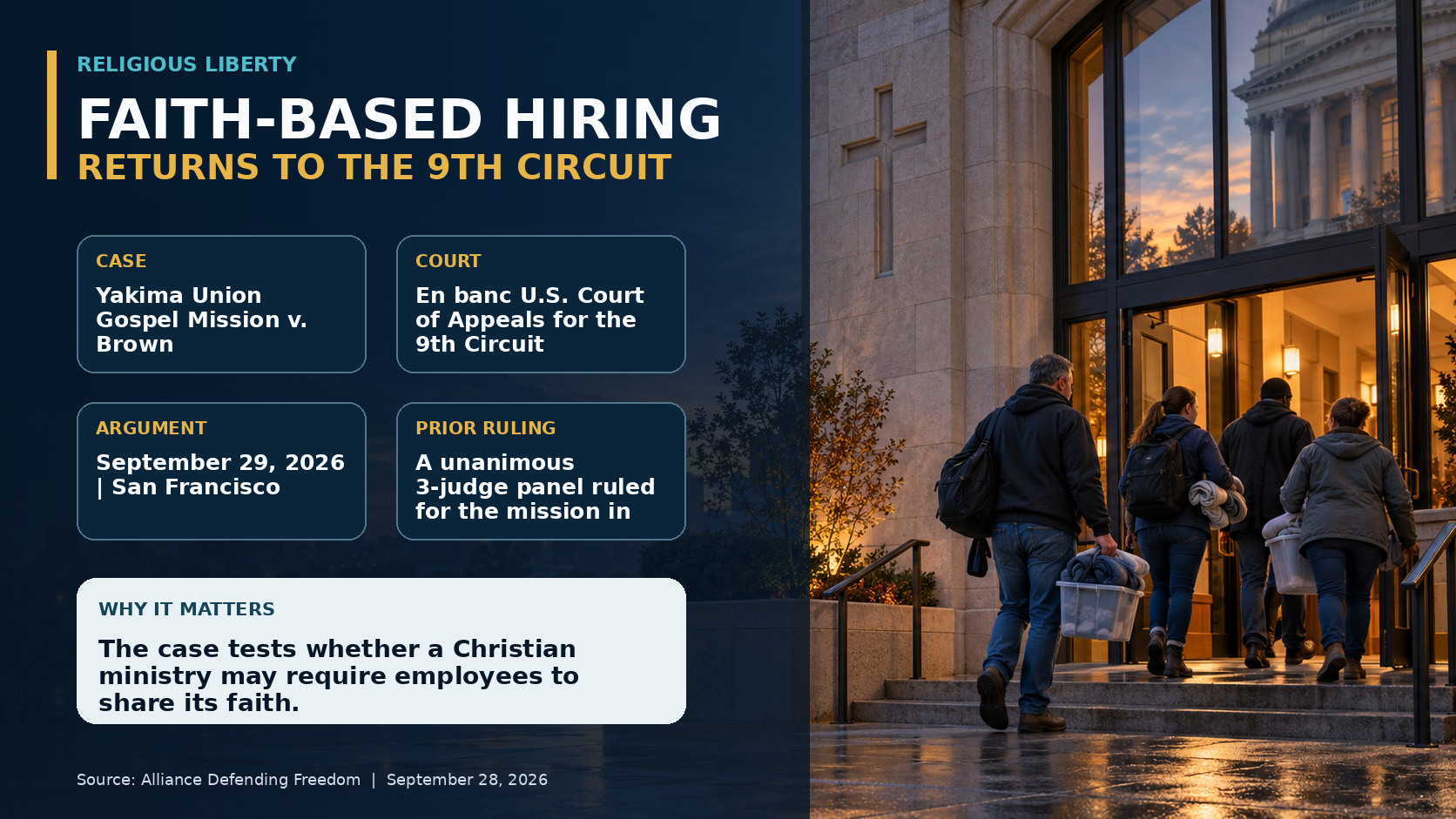
A federal appeals court is reconsidering whether Yakima Union Gospel Mission may require employees to share its Christian faith. The en banc review follows a unanimous panel ruling for the ministry and carries nationwide significance for churches and faith-based nonprofits that organize their work, staffing, and public service around sincerely held religious convictions.

The U.S. Court of Appeals for the Ninth Circuit has returned a closely watched ministry employment dispute to its full en banc court, placing the religious character of a Christian homeless ministry at the center of a nationwide legal conversation. Alliance Defending Freedom announced on September 28, 2026, that the court would hear oral argument the following morning in Yakima Union Gospel Mission v. Brown. The case asks whether Washington state may apply its employment law in a way that prevents Yakima Union Gospel Mission from reserving ministry positions for people who affirm and live according to the organization’s Christian beliefs. The mission serves people facing homelessness and addiction while presenting its work as an expression of the gospel. According to the organization’s legal counsel, shared faith is not incidental to those services. It shapes prayer, discipleship, spiritual care, workplace expectations, and the message staff members communicate to guests. A unanimous three-judge Ninth Circuit panel ruled for the mission in January, recognizing its First Amendment interest in choosing employees who share its beliefs. The full court’s reconsideration now puts that earlier ruling under review. Oral argument was scheduled for September 29 in San Francisco. Although the dispute arises from one Washington ministry, the underlying question reaches far beyond a single employer. Churches, rescue missions, schools, camps, publishers, counseling ministries, and other Christian nonprofits often depend on staff members to carry out religious responsibilities throughout ordinary daily work. A ruling that treats those responsibilities as separate from an organization’s faith commitments would influence how ministries describe roles, evaluate applicants, and preserve a coherent Christian witness while serving the public.
The case matters to Christian leaders because employment decisions often express a ministry’s theology in concrete form. A statement of faith has limited practical force if an organization must assign spiritually significant work to people who openly reject the beliefs the ministry exists to proclaim. At the same time, leaders following this dispute should resist reducing every job description to a legal defense. The stronger course is to clarify, honestly and consistently, how each position advances the ministry’s religious mission. Churches and nonprofits should identify responsibilities such as prayer, discipleship, teaching, pastoral care, hospitality, witness, and spiritual accountability wherever those responsibilities are genuine. They should also review governing documents, employee handbooks, application materials, and conduct expectations so the written record matches actual practice. The Ninth Circuit’s final decision will turn on constitutional and statutory questions, but its pastoral lesson is already visible. Christian service and Christian identity are difficult to separate when a ministry understands compassion as obedience to Christ. This dispute also deserves careful attention from donors, volunteers, and church partners because a change in hiring freedom would affect the people who represent ministries to vulnerable neighbors. The legal process is ongoing, so readers should distinguish the January panel ruling from the en banc court’s future judgment. No final outcome should be assumed from the questions asked at argument. For now, the most useful response is informed preparation rather than alarm. Ministry boards should seek qualified legal guidance, state their beliefs with precision, apply policies consistently, and explain to supporters why shared faith relates to the work. The case provides a timely opportunity for Christian organizations to examine whether their staffing practices faithfully reflect both their public commitments and the spiritual purposes for which they were formed.
Religious Liberty and Ministry Employment
Evangelical; Interdenominational
Pastors; Ministry Leaders; Christian Nonprofit Leaders; Religious Liberty Advocates
Alliance Defending Freedom

Free to Believe: The Battle Over Religious Liberty in America
Luke Goodrich
Luke Goodrich’s hardcover guide explains the legal and theological pressures surrounding religious liberty in the United States, offering useful context for a ministry employment case. ASIN 0525652906.