
Adventist Leaders Review Standardized Lay-Ministry Credential Amid Pastoral Shortage
November 7, 2026
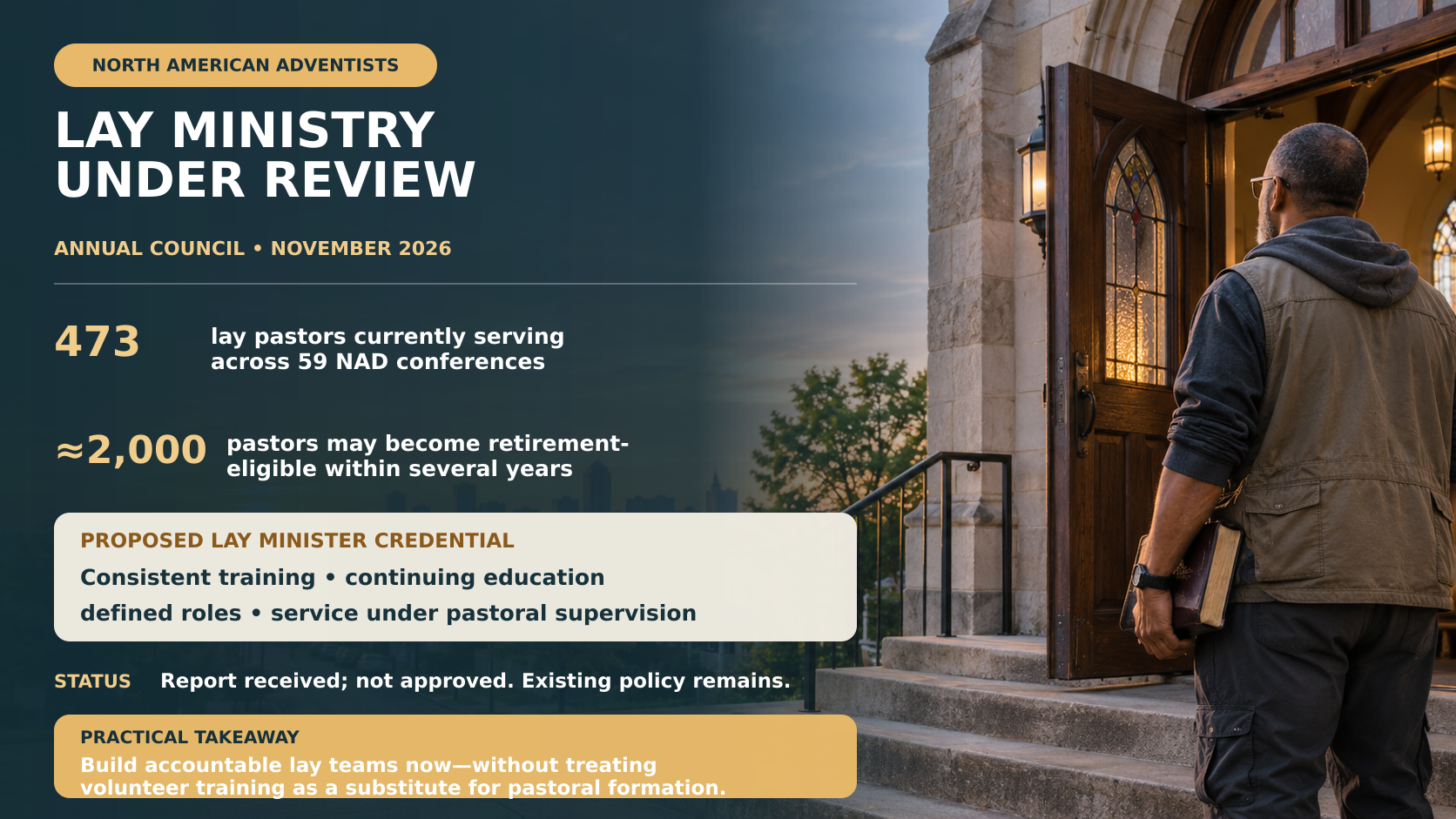
North American Adventist leaders have reviewed a proposed credential that would standardize training and responsibilities for volunteer lay pastors serving under pastoral supervision. The discussion matters nationally as hundreds of lay pastors already serve across the denomination, roughly 2,000 pastors may soon reach retirement eligibility, and congregations in both large cities and remote communities face distinct ministry needs.

Adventist News Network reported on November 7, 2026, that the North American Division Annual Council examined urban mission, pastoral shortages, volunteer ministry, and new evangelism resources for local congregations. A central discussion concerned a proposed Lay Minister Credential, presented as a standardized framework for church members who volunteer in pastoral roles. According to the report, 473 lay pastors currently serve across the North American Division’s 59 conferences, but their training and authorization requirements vary. The proposal would establish consistent training standards, continuing-education expectations, and defined responsibilities for lay ministers who serve under a pastor’s supervision. The article carefully distinguishes the credential from ordained ministry: it would not replace seminary education, qualify a participant for ordination, or create a pathway to paid pastoral employment. Delegates voted to receive the report but did not approve the credential for implementation, and North American Division president G. Alexander Bryant clarified that existing policies remain unchanged while the framework continues to be developed. The urgency behind the discussion is substantial. Bryant said approximately 2,000 pastors could become eligible for retirement within several years, while enrollment in theology and religion programs at Adventist universities remains comparatively low. Council members also considered the different mission pressures facing urban and rural churches. Leaders discussed language and cultural barriers in diverse cities, as well as limited resources, long travel distances, and pastoral shortages in smaller and remote communities. Reports from the field included a multi-church mobile shower ministry serving people experiencing homelessness in St. Louis, an evangelism and discipleship school, wildfire response in eastern Washington, and new Bible-study and broadcast resources. The nationwide significance is not that a final credential was adopted, but that a large Christian denomination is openly testing how trained lay service can strengthen mission without confusing volunteer responsibility with pastoral office and preparation.
Congregations can learn from the council’s unfinished discussion without pretending the proposal is already policy. The immediate opportunity is to audit who is already carrying pastoral-like responsibilities: Bible teachers, small-group leaders, visitation volunteers, elders, ministry coordinators, chaplaincy workers, and members serving distant or language-specific communities. Churches can then define which tasks require ordained pastoral oversight, which may be delegated, what biblical and doctrinal preparation is necessary, and how volunteers will receive supervision, safeguarding instruction, continuing education, and honest feedback. A credential can create consistency, but a certificate alone cannot supply character, calling, theological maturity, or relational accountability. Likewise, refusing to develop lay leaders can leave overextended pastors isolated and congregations vulnerable when retirements or vacancies arrive. The most responsible middle path is team-based ministry in which members are trained for real service while pastors remain accountable for doctrine, discipline, sacraments or ordinances as their tradition understands them, and the care of the flock. Rural churches may need shared regional training and digital access; urban congregations may need multilingual resources, cross-cultural mentors, and partnerships that address practical neighborhood needs alongside evangelism. The recommended book, the 2021 second edition of The Trellis and the Vine: The Ministry Mind-Shift That Changes Everything by Colin Marshall and Tony Payne, asks churches to distinguish organizational structures from the prayerful work of teaching God’s Word and making disciples. Its picture of pastors as trainers and Christians as disciple-making disciples fits the council’s concern for mobilizing members, while also warning that programs and credentials should serve gospel ministry rather than become ends in themselves. The book reflects an evangelical framework rather than official Adventist policy, so it should be read critically alongside Scripture and denominational guidance. A practical next step is for each congregation to name its current lay ministers, assign qualified supervision, document boundaries, and create a twelve-month development plan before staffing pressure becomes an emergency.
Lay Ministry, Pastoral Formation, and Urban Mission
Seventh-day Adventist
Pastors, Lay Leaders, Denominational Leaders, and Congregations
Adventist News Network
The Trellis and the Vine: The Ministry Mind-Shift That Changes Everything
Colin Marshall and Tony Payne
Marshall and Payne distinguish ministry structures from prayerful Word-centered disciple making and emphasize equipping Christians for service, a useful framework for evaluating standardized lay training without confusing credentials with pastoral formation.