
Barna Finds Married Fathers Lead Parent Church Attendance
October 16, 2026
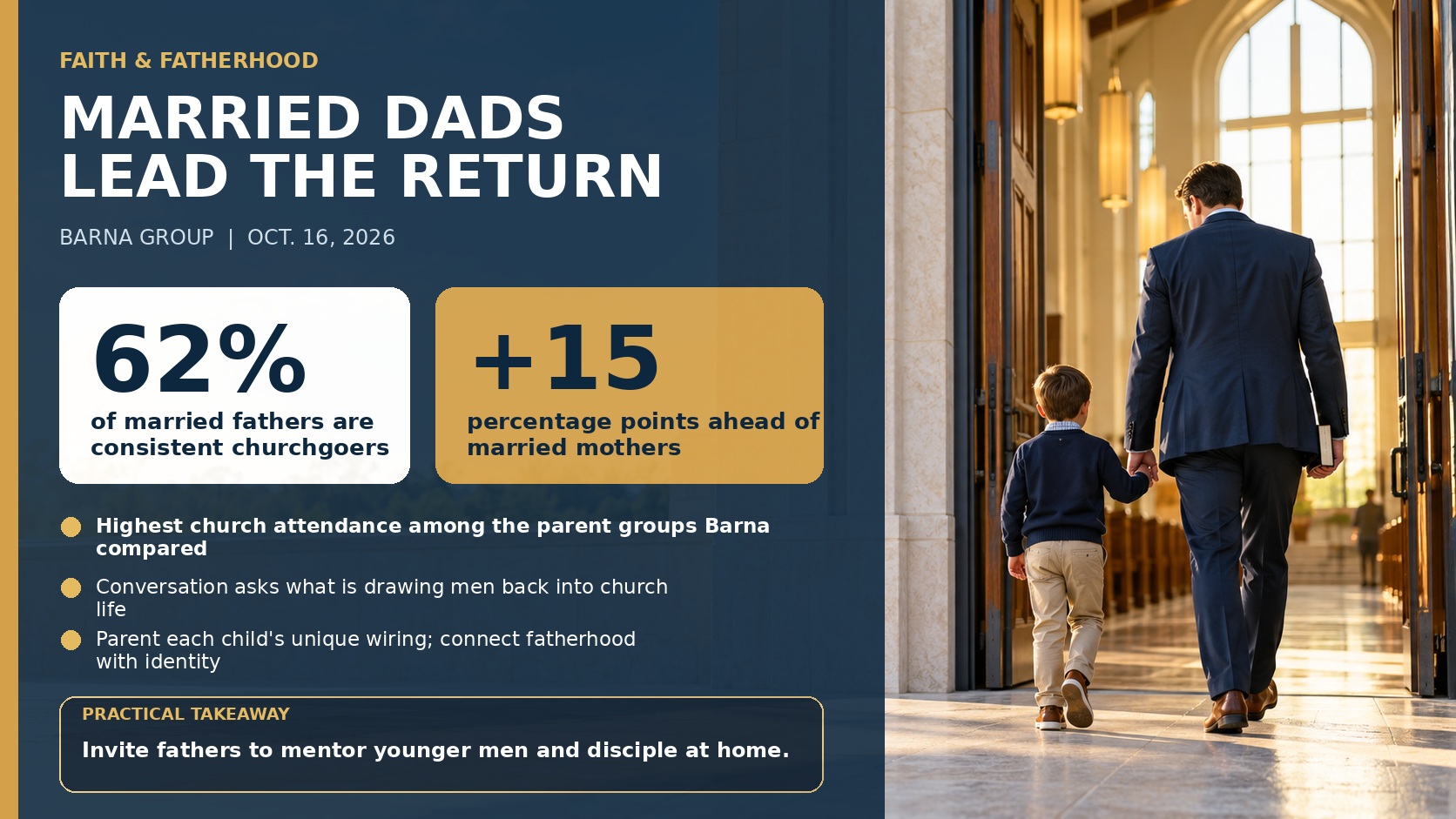
New Barna data reports that 62% of married fathers are consistent churchgoers, the strongest attendance level among parent groups and 15 points above married mothers. The finding matters because it gives congregations a timely opening to strengthen fatherhood, invite men into genuine community, and connect church participation with everyday discipleship at home.

Barna Group’s October 16 conversation with pastor and author Bryan Loritts highlights a notable shift in the relationship between fathers and congregational life. According to the episode summary, 62 percent of married fathers are now the most consistent churchgoers among the parent groups Barna compared, placing them 15 percentage points ahead of married mothers. The source presents the number as a starting point for asking what is drawing men back to church, not as a reason for triumphalism or a verdict on mothers. That distinction matters. Attendance can create opportunities for worship, Scripture, friendship, service, accountability, and pastoral care, but simply entering a building does not automatically form a faithful father. Loritts brings the statistical finding into contact with lived experience as the father of three young adult sons. The conversation considers why unplanned moments often become the memories children keep, how a child’s initiative can reshape a parent’s understanding of relationship, and why each son or daughter should be parented according to his or her unique wiring. It also addresses the challenge of stepping out from a father’s shadow into a God-given identity. For churches serving families across the United States, the development is encouraging because it points to men who may be more open than common stereotypes suggest. It is also a pastoral responsibility: congregations should welcome fathers without reducing them to a demographic, and they should help men translate participation into patient presence, truthful speech, repentance, prayer, and a durable love for their children. That work begins with sustained attention to Christ.
The most useful ministry response is therefore not a publicity campaign built around one percentage, but a deeper pathway from attendance to discipleship. A church can begin by listening to fathers at different stages: men raising toddlers, single fathers, stepfathers, adoptive fathers, grandfathers, men whose children are adults, and men carrying grief or regret about their own fathers. That listening can reveal practical barriers and spiritual needs that a national number cannot show. Congregations can then connect men with small groups, Bible study, service, prayer, and intergenerational relationships where honesty is possible. Barna’s episode links to Spiritual Fathers, a resource designed to equip mature Christian men to mentor and disciple younger men; that emphasis is especially relevant because fatherhood is learned not only through instruction but also through faithful examples. Churches should likewise honor the essential ministry of mothers and resist framing family discipleship as a competition between women and men. The 15-point difference is descriptive data, not a mandate to compare parents in ways that diminish either one. A healthier application is to ask how fathers’ renewed presence can strengthen the whole household and how congregations can support parents together. Loritts’s emphasis on identity and each child’s distinct wiring also cautions against formulaic parenting. Biblical fatherhood is not the performance of a single personality type. It is a calling to know a child, keep promises, offer appropriate guidance, practice integrity, create shared experiences, and point beyond oneself to the grace of God. If churches act on the finding with humility, they can help today’s consistent attendance become tomorrow’s steadier homes, wiser mentors, and more faithful transmission of the gospel to the next generation.
Christian Fatherhood and Family Discipleship
Evangelical; Interdenominational
Christian Fathers; Parents; Pastors; Men’s Ministry Leaders; Family Ministry Teams; Mentors
Barna Group

The Dad Difference: The 4 Most Important Gifts You Can Give to Your Kids
Bryan Loritts
Bryan Loritts expands the story’s fatherhood theme through four biblical gifts—relationship, integrity, teaching, and experiences—that fathers can practice with their children. Paperback edition; ASIN 0802419623.