
Barna Finds Most Churches Still Lack AI Guidelines Pastors Want
October 6, 2026
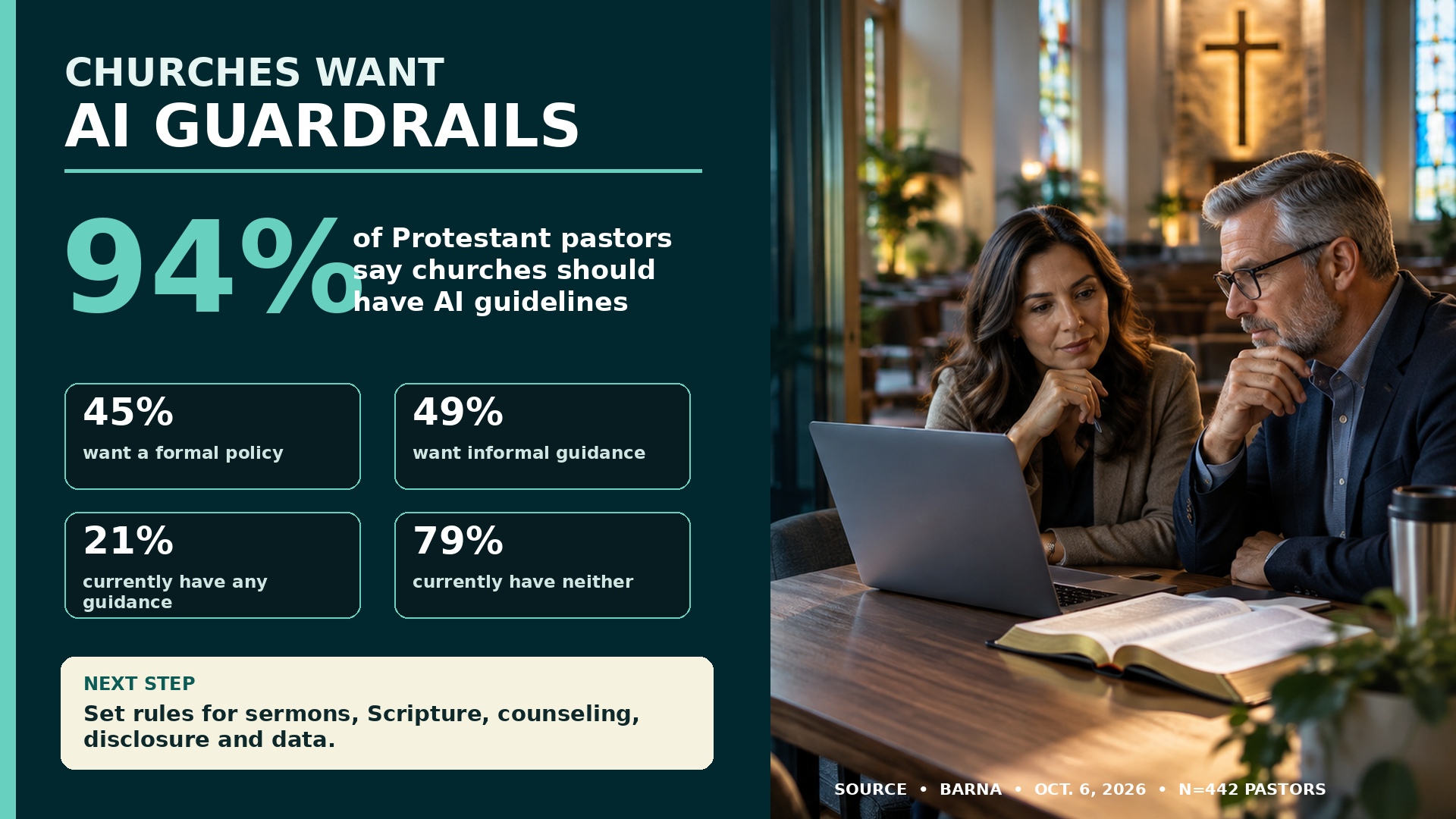
Barna reports that 94 percent of U.S. Protestant pastors believe churches should have formal policies or informal guidance for artificial intelligence, yet only 21 percent say their congregation currently has either. The gap matters because AI is already entering sermon preparation, research, administration and discipleship while many churches have not defined accountability, disclosure or pastoral limits.

Barna Group reported on October 6, 2026, that U.S. Protestant pastors overwhelmingly want churches to establish boundaries for artificial intelligence, but most congregations have not yet done so. In Barna’s survey of 442 pastors, conducted online in December 2025 with quotas intended to represent U.S. Protestant churches by size, denomination and region, 94 percent said a church should have either a formal AI policy or informal guidance. The preference divided almost evenly: 45 percent favored a formal policy and 49 percent favored informal guidance, while only 6 percent said neither was needed. Current practice looks very different. Just 4 percent of pastors said their church had a formal policy, 17 percent reported informal guidance and 79 percent said their church had neither. That means only about one church in five had any stated direction even though nearly every pastor believed some direction should exist. Barna’s related findings show why the gap is not theoretical. Thirteen percent of pastors said they did not use AI at all, while half reported using it for brainstorming. Thirty-six percent used it for biblical or theological research, 34 percent for small-group content or administrative tasks and 24 percent for sermon writing or editing. Pastors were more comfortable with AI-assisted curriculum than with uses that more directly imitate spiritual or pastoral judgment: 64 percent viewed curriculum use positively, compared with 37 percent for prayers, 33 percent for worship songs, 29 percent for interpreting Scripture, 27 percent for sermons and 10 percent for spiritual counseling. The pattern suggests that many leaders distinguish between a tool supporting ministry work and a system appearing to perform a shepherd’s spiritual responsibility.
The findings give church boards and ministry teams a practical agenda. A useful policy does not need to begin as a long technical manual; it can start with clear theological and pastoral commitments. Leaders can identify tasks for which AI may assist human work, tasks that require direct pastoral authorship or judgment and tasks that should remain outside automated systems. Sermons and Bible teaching deserve special care because congregations reasonably expect a preacher to study Scripture, pray, exercise discernment and take responsibility for what is proclaimed. Research tools can accelerate discovery, but they can also produce invented sources, flatten theological differences or reproduce bias, so every claim and citation needs human verification. Counseling and prayer raise additional concerns because confidential details, spiritual vulnerability and pastoral trust should not be uploaded casually to commercial systems. Churches should also decide when AI assistance should be disclosed, who approves public-facing material, how staff protect personal data and how errors will be corrected. The most constructive response is neither panic nor uncritical enthusiasm. Technology can help with outlines, translation, scheduling, accessibility and routine administration, but efficiency is not the church’s highest good. Faithfulness, truth, love of neighbor, wise stewardship and accountable human relationships remain the governing aims. A small team of pastors, elders, communicators, educators and technically knowledgeable members can draft initial guidance, test it against real ministry scenarios and revisit it regularly as tools change. Barna’s data show that pastors already recognize the need. The next step is to turn that recognition into shared practice before individual habits become an unexamined congregational standard.
Church Technology Ethics and Pastoral Accountability
U.S. Protestant; Evangelical; Mainline Protestant; Church Leadership
Pastors; Elders; Ministry Staff; Church Communicators; Christian Educators; Congregations
Barna Group

Following Jesus in a Digital Age
Jason Thacker
Verified 2022 B&H trade paperback, ASIN 1087754593. Jason Thacker offers a Scripture-grounded framework for wisdom, truth, responsibility and Christian identity amid digital technology, directly supporting a church conversation about AI boundaries.