
Barna Trust Data Puts Pastoral Character Above Celebrity
October 15, 2026
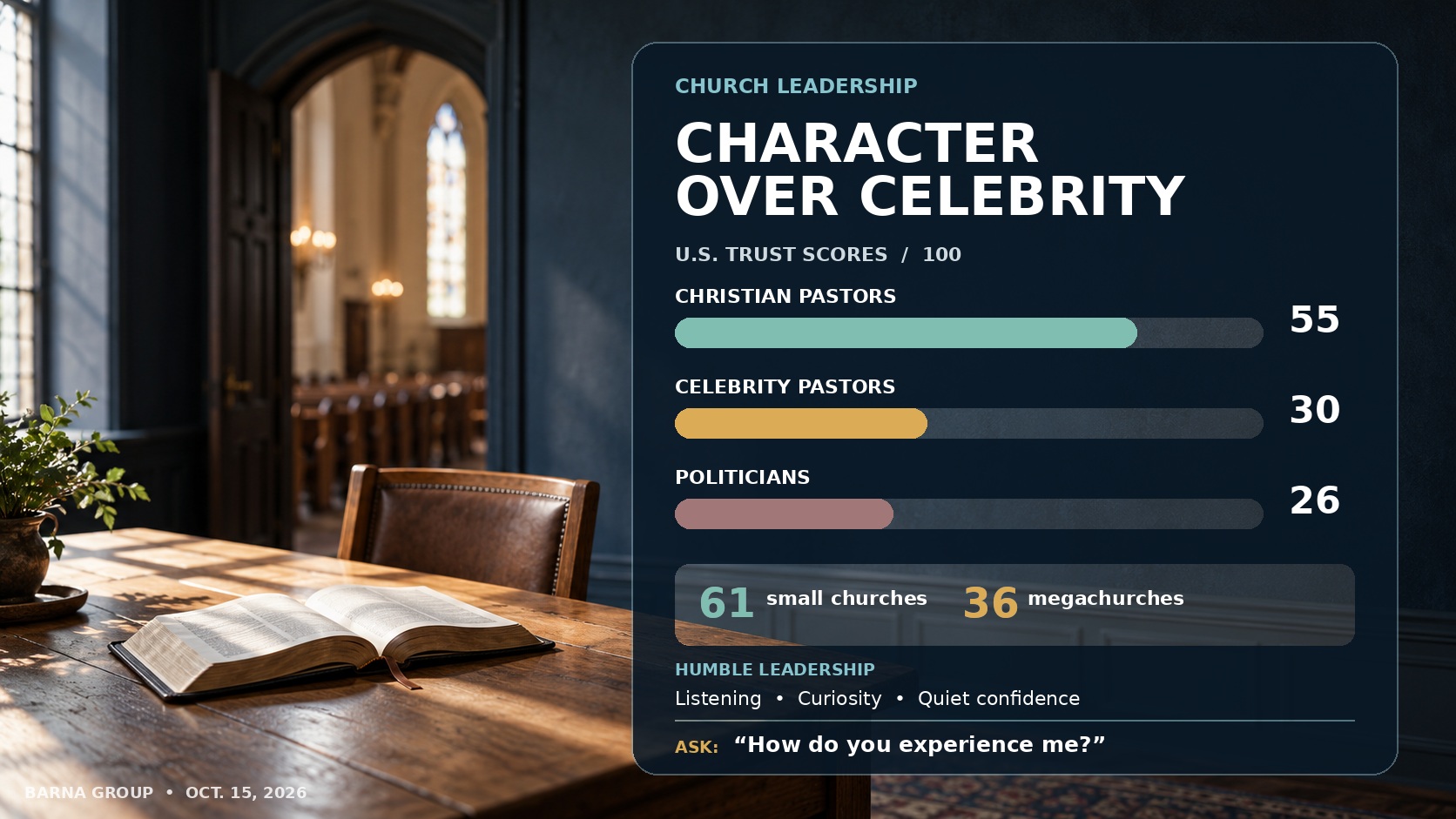
Barna’s latest leadership conversation reports a 30-out-of-100 trust score for celebrity pastors, compared with 55 for Christian pastors overall and 26 for politicians. The gap challenges churches to prize integrity, proximity, listening, and accountable character over visibility—an urgent concern for congregations seeking to rebuild trust one relationship at a time.

A new Barna Group episode published October 15 places the character of Christian leadership against a sobering national trust landscape. In the conversation, David Kinnaman and Ashley LaLonde speak with Chuck DeGroat, a professor of pastoral care and Christian spirituality, licensed therapist, and author, about trust, narcissism, and the slow work of becoming a healthy leader. Barna reports that celebrity pastors score 30 out of 100 among U.S. adults, only four points above politicians at 26 and well below Christian pastors overall at 55. The related 2026 trust study gives the comparison additional context. Small churches score 61 on Barna’s index while megachurches score 36, a 25-point difference that reinforces the report’s conclusion that trust tends to run local, small, and knowable. The study surveyed 2,000 U.S. adults in February 2026 and converted four-point trust ratings to a zero-to-100 scale before averaging the results. Those details are important because the scores are an index, not percentages of people who unconditionally trust a group. They still communicate a clear pattern: public visibility and institutional scale do not guarantee credibility. Barna’s reporting says Christian pastors outscore celebrity pastors by 25 points, yet pastors themselves remain below Christian churches, Christian businesses, and Christian nonprofits in the same study. That mixed picture calls for neither despair nor defensiveness. It invites sober attention to how leaders are known by the people closest to them and how daily consistency, care, truthfulness, and accountability shape a congregation’s confidence over time. Such confidence must be earned again each day.
DeGroat’s contribution helps move the discussion beyond a simplistic contrast between good and bad personalities. The episode frames narcissism less as obvious grandiosity than as fear and self-protection, which can appear in leaders who crave the microphone as well as leaders who control quietly, avoid correction, or preserve an image at other people’s expense. DeGroat recounts his own early confrontation with arrogance, and the hosts identify listening, curiosity, and a quiet confidence that does not need constant attention as marks of humility. The practical question they commend—“How do you experience me?”—is useful precisely because it asks a leader to receive another person’s reality without first managing the answer. Churches can build on that posture through plural leadership, meaningful board oversight, clear financial and safeguarding practices, healthy complaint processes, regular sabbath, and relationships in which pastors are known apart from their platform. Barna’s broader report advises leaders to prioritize neighborhood engagement, personal relationships, integrity, consistency, and tangible care. It also notes that small congregations can treat close knowledge of people as a ministry advantage rather than apologize for lacking scale. None of these steps requires churches to reject gifted communication or broad influence. The issue is whether influence remains answerable to Christian character and whether organizational systems protect truth when a leader’s reputation is at stake. Trust can be lost quickly, but Barna argues that it is usually built or rebuilt in ordinary interactions: a hard conversation handled honestly, a neighbor served without fanfare, a wounded member treated with dignity, or a leader who repents without qualification. For congregations nationwide, the data makes character formation a public witness. Churches that choose humility over celebrity can become more credible places of worship, healing, and discipleship.
Pastoral Character and Church Trust
Evangelical Protestant — Multidenominational
Pastors; Elders; Church Boards; Ministry Leaders; Seminary Students; Congregations
Barna Group

When Narcissism Comes to Church: Healing Your Community from Emotional and Spiritual Abuse
Chuck DeGroat
Chuck DeGroat examines narcissism in ministry leaders and church systems, offering compassionate guidance for wounded communities and a gospel-shaped path toward repentance and healing. Hardcover edition; ASIN 0830841598.