
Bible Release-Time Settlement Restores Equal Access in Washington Schools
October 13, 2026
A settlement approved by Everett Public Schools restores equal-access safeguards for LifeWise Academy's voluntary Bible release-time program. The agreement adds district policy changes, board religious-liberty training, a public apology, and payment of attorneys' fees—an important development for Christian parents and educators watching how public schools apply released-time protections.

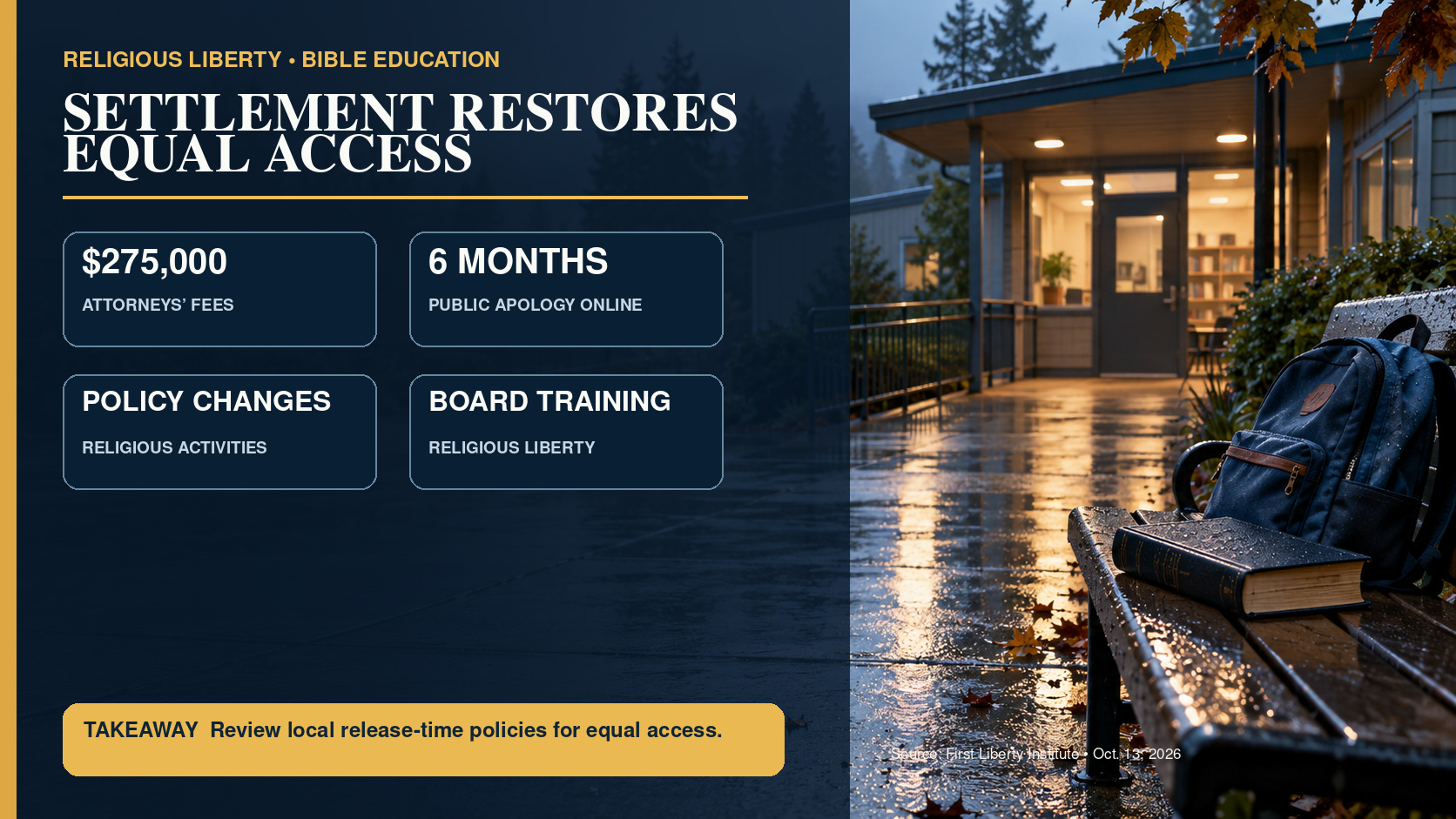
Everett Public Schools in Washington approved a settlement with LifeWise Academy after a federal dispute over access for a voluntary, off-campus Bible education program. First Liberty Institute reported on October 13, 2026, that the agreement requires changes to district policies governing religious activities, religious-liberty training for the school board, and a written public apology that will remain visible for six months. The district also agreed to pay $275,000 in attorneys' fees. LifeWise describes its programs as voluntary Bible instruction offered during the school day under state released-time laws, with participating students leaving campus with parental permission. The dispute centered on restrictions that LifeWise said treated its religious program differently from comparable community organizations. Among the challenged measures were limits on LifeWise participation in community events and flyer distribution, a requirement that materials sent home be placed in sealed envelopes, and a weekly parent-reauthorization process. In April 2026, a federal court issued a preliminary injunction while the litigation proceeded. The settlement now supplies concrete remedies rather than leaving the parties to continue a lengthy court fight. It does not create a general rule automatically binding every school district in the country, and the particular terms address Everett's policies and conduct. Still, the combination of policy revision, training, apology, and fee payment makes the resolution significant for churches, parents, Christian educators, and school administrators who follow released-time programs. It also underscores that voluntary religious instruction connected to public-school schedules must operate within carefully defined legal boundaries, including parental choice, off-campus instruction, and neutral access rules.
The national importance of the Everett settlement lies less in a single local program than in the practical questions it raises for any community considering released-time Bible education. School officials may regulate student safety, attendance, transportation, and instructional time, but policies involving religious organizations should be written and applied without singling out faith-based speakers for disfavored treatment. Christian ministries likewise need disciplined procedures: clear parental consent, dependable transportation, accurate attendance records, appropriate safeguarding, and communication that never implies school endorsement. The agreement's training requirement is especially useful because many conflicts develop from uncertainty among board members and staff rather than from a written decision to exclude religion. A careful policy review can identify whether community-access rules use neutral criteria, whether flyer or event opportunities are open on the same terms, and whether authorization requirements are reasonable and consistently applied. Parents and church leaders should read both the First Liberty account and Everett Public Schools' current student-release guidance rather than relying on social-media summaries. They should also distinguish released-time instruction from classroom religious exercises: the former is voluntary and normally occurs off campus, while public schools themselves remain responsible for constitutional neutrality. For ministry leaders, the practical takeaway is to build cooperation early. Meet with district administrators, document comparable community uses, explain supervision and transportation plans, and obtain legal counsel before a disagreement hardens. For school leaders, the lesson is equally constructive: neutral rules, staff training, and transparent communication can protect families of different convictions while reducing litigation risk. The settlement therefore matters beyond one Washington district because it offers a real-world checklist for honoring parental decisions, maintaining orderly schools, and treating religious and nonreligious community partners by the same stated standards.
Bible Education and Student Religious Liberty
Evangelical; Interdenominational
Parents; Church Leaders; Christian Educators; Religious Liberty Advocates
First Liberty Institute

Religious Liberty in Crisis: Exercising Your Faith in an Age of Uncertainty
Ken Starr
Ken Starr's 2021 Encounter Books hardcover explains the constitutional and civic stakes of religious liberty, giving readers helpful context for equal treatment of voluntary faith-based programs.