
CEA Policy Summit 2026 Will Bring Christian Employers to Washington
October 8, 2026
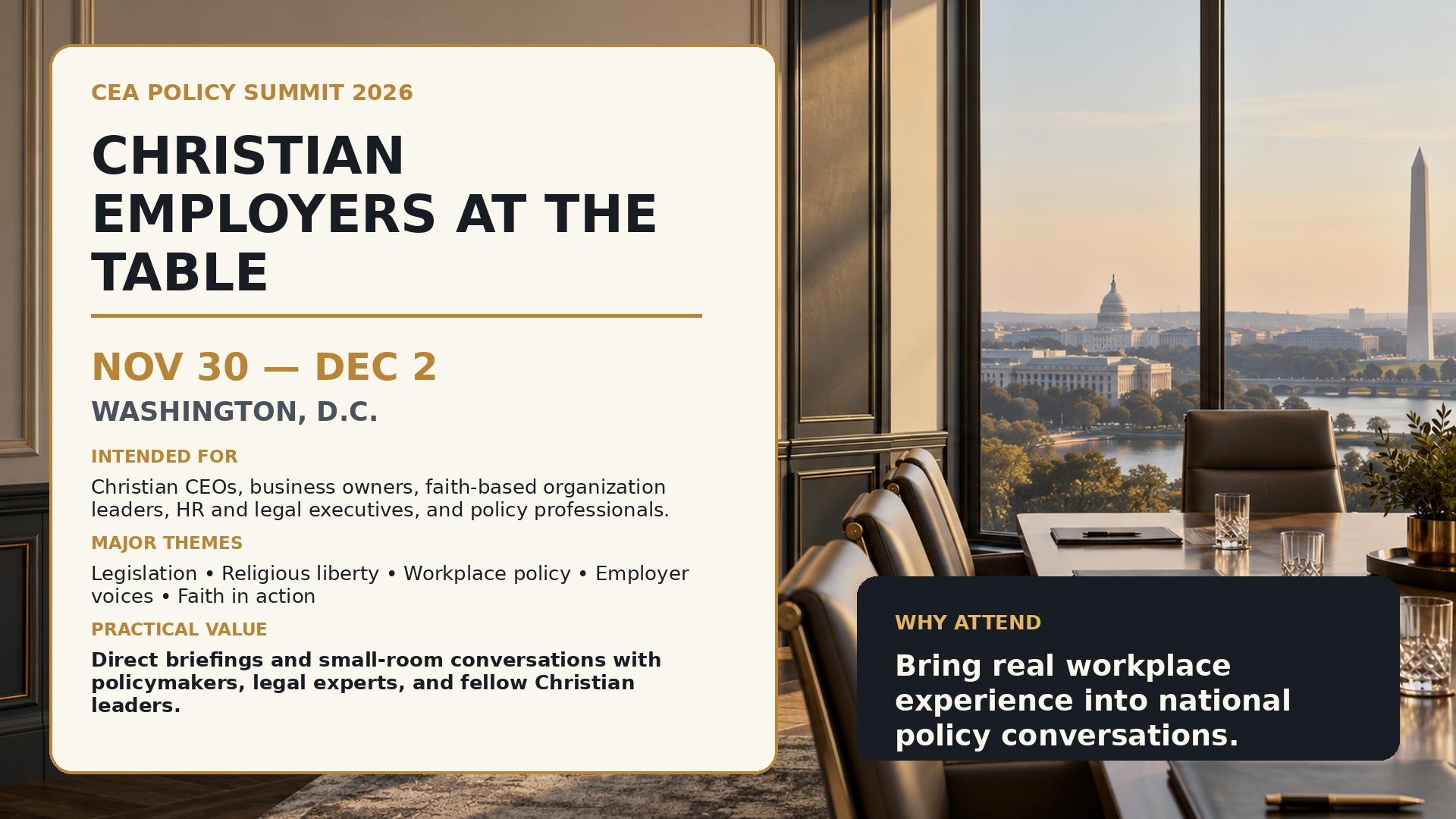
Christian Employers Alliance will hold its 2026 Policy Summit in Washington, D.C., November 30–December 2. Designed for Christian CEOs, business owners, faith-based ministry leaders, HR and legal executives, and policy professionals, the limited-attendance gathering will focus on workplace legislation, religious liberty, employer experience, and direct conversations with policymakers. Its practical aim is to help faith-driven leaders understand and influence rules affecting their organizations.

The Christian Employers Alliance Policy Summit 2026 is scheduled for November 30 through December 2 in Washington, D.C., with accommodations offered through a reserved room block at the Thompson Washington D.C. The official event page presents the summit as a limited-attendance delegation for Christian CEOs, business owners, presidents and executive leaders, faith-based organizational leaders, human-resources and legal executives, policy professionals, government-relations leaders, alliance members, and strategic partners. Rather than describing a large convention, the organizers emphasize small-room conversations among employers, policymakers, administration officials, legal experts, business leaders, and national voices. The agenda begins Monday evening with a welcome reception and book signings. Tuesday includes policy engagement, member stories, recognition, and a congressional awards ceremony. Wednesday moves to Capitol Hill for a Senate briefing luncheon, employer testimony about workplace and community experience, and a closing reception and dinner. The official page says the program will address legislation, agency action, religious-liberty concerns, workforce and healthcare challenges, regulation, financial policy, and the freedom of Christian organizations to operate according to their beliefs. Selected members are invited to explain how public policy affects their businesses and ministries and to describe ways their organizations serve employees, families, communities, and Christian causes. The alliance also identifies access, intelligence, and influence as three intended benefits: meeting decision-makers, understanding current legislation and legal disputes, and placing the experience of faith-driven employers into policy discussions. Registration is open, seats are limited, and the event page advises prospective attendees to reserve accommodations early if they plan to use the designated hotel block.
The summit is especially relevant for Christian leaders who carry both spiritual commitments and legal responsibility for employees, benefits, policies, and organizational culture. Workplace decisions are rarely abstract for an employer. Hiring practices, insurance design, accommodation requests, employee speech, privacy, and compliance obligations affect real people and can expose a ministry or business to significant legal and financial risk. A policy gathering can be useful when it helps leaders distinguish biblical conviction from partisan reflex, understand the actual text and status of legislation, and hear from attorneys or officials who can explain where authority begins and ends. Attendees should approach the summit ready to describe specific operational questions rather than only broad cultural concerns. Human-resources and legal leaders may benefit from bringing examples of policy language, recurring employee questions, or compliance challenges to guide their conversations, while business owners can prepare concise accounts of how regulation affects their workforce and community service. The event also offers a chance to build peer relationships with leaders who face similar tensions but work in different industries or ministry settings. Those relationships can continue after the Washington meetings through referrals, shared resources, and mutual prayer. Participation does not remove the need for organization-specific legal advice, careful pastoral judgment, or respectful treatment of every employee. It can, however, give decision-makers a clearer picture of pending policy, the religious-liberty arguments being advanced, and the practical consequences that national leaders may otherwise overlook. For a Christian employer, the most constructive reason to attend is not proximity to political power for its own sake, but the opportunity to bring truthful workplace experience into public conversation while learning how to lead with integrity, prudence, and consistent Christian conviction.
Christian Workplace Policy and Employer Advocacy
Christian — Multidenominational
Christian CEOs, business owners, faith-based organization leaders, HR and legal executives, and policy professionals
Christian Employers Alliance

Business for the Glory of God: The Bible’s Teaching on the Moral Goodness of Business
Wayne Grudem
Wayne Grudem’s Crossway hardcover considers ownership, employment, profit, lending, and other business activities through a biblical framework, directly complementing a summit for employers seeking to operate with Christian conviction.