
Clergy Act Creates New Social Security Choice for Eligible Ministers
October 21, 2026
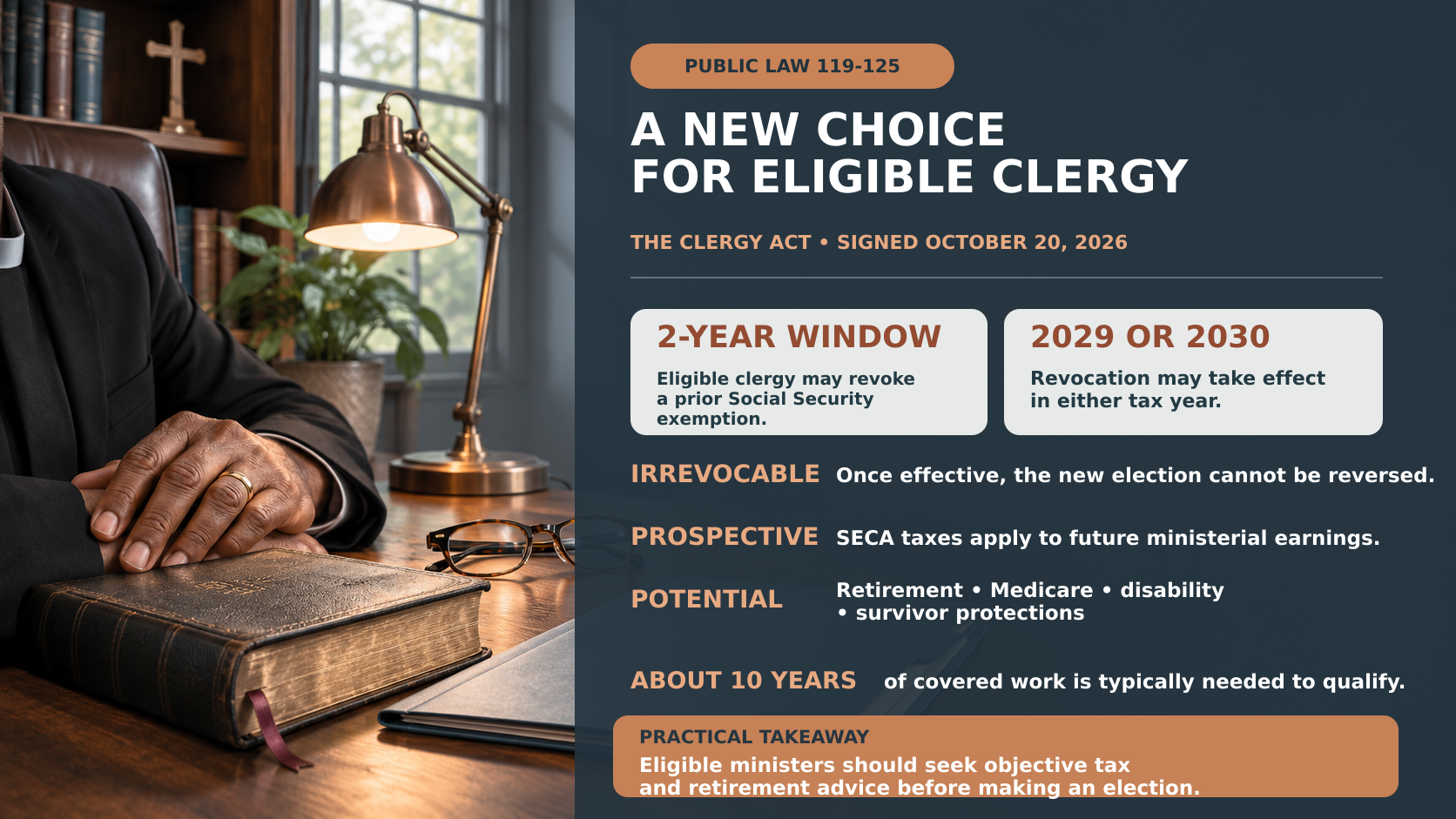
The newly enacted Clergy Act gives eligible ministers who previously opted out of Social Security a limited opportunity to elect future coverage. The nationwide change matters for pastors and ministry families because the decision can affect future taxes, retirement income, Medicare eligibility, disability protection, and survivor benefits—and an effective revocation cannot later be reversed.

Baptist Press reported on October 21, 2026, that the Clergy Act had been signed into law one day earlier, creating a new nationwide decision point for certain ministers who previously received an exemption from Social Security coverage on ministerial earnings. The official law is Public Law 119-125, enacted from H.R. 227. According to the White House and the Government Publishing Office, the statute allows a two-year period in which eligible ministers of a church, members of a religious order, and Christian Science practitioners may apply to revoke a prior exemption. A Congressional Research Service summary explains that a revocation may take effect in either the 2029 or 2030 tax year, as specified in the application, and becomes irrevocable once effective. The change is prospective: ministers who elect coverage will pay Self-Employment Contributions Act taxes on future ministerial earnings rather than retroactively rebuilding every prior year. Ministers have a distinctive federal tax status because they are generally treated as self-employed for Social Security purposes even when a church treats them as employees for income-tax withholding. GuideStone Financial Resources, which supported the legislation with other church and benefit organizations, said it is preparing education on eligibility, deadlines, retirement planning, and individual evaluation. Depending on a minister’s circumstances and accumulated covered work, Social Security participation may support retirement benefits, Medicare eligibility beginning at age sixty-five, disability protection, and survivor benefits for eligible family members. Baptist Press cited information from Senator Katie Britt indicating that a person who opts back in will typically need about ten years of covered work to qualify for benefits. That benchmark is general, not a promise of eligibility or a personalized benefit calculation.
Churches and ministers should treat the new law as an opportunity for careful planning, not as a blanket instruction that every eligible person should make the same election. The first task is to confirm eligibility under the law and any Internal Revenue Service procedures issued before the window opens. A minister should then gather the original exemption record, Social Security earnings history, expected years of future ministry, other covered employment, spouse and dependent information, existing retirement assets, disability coverage, life insurance, and projected housing needs. Because the revocation is irrevocable after it takes effect, informal advice from colleagues or a quick online estimate is not enough. A qualified tax professional who understands clergy tax rules can explain the prospective SECA obligation, while an independent retirement adviser can compare possible Social Security benefits with current savings and risk protection. Church finance teams also need to understand the difference between a minister’s Social Security tax treatment and ordinary employee payroll treatment; they should not change compensation or withholding practices until they have reliable guidance and the minister has made an informed decision. Congregations can serve pastors by providing access to competent advice without steering the outcome or pressuring a minister to choose the option that is cheapest for the church. The recommended book, Master Your Money: A Step-by-Step Plan for Gaining and Enjoying Financial Freedom, is the 2016 paperback by Ron Blue with Jeremy White. It offers biblically grounded planning on saving, investing, taxes, estate needs, debt, and generosity. The book is not a substitute for current clergy-tax counsel, but it can help ministry households place the Clergy Act decision within a complete financial plan shaped by stewardship rather than fear. The wisest preparation now is to preserve records, watch for official IRS and GuideStone instructions, and schedule professional review well before the 2029 election period.
Minister Financial Security and Public Policy
Broad Christian
Pastors, Ministers, Church Staff, Finance Leaders, and Families
Baptist Press

Master Your Money: A Step-by-Step Plan for Gaining and Enjoying Financial Freedom
Ron Blue with Jeremy White
Blue and White provide a biblical framework for long-term saving, taxes, investing, estate needs, debt, and generosity, helping ministry households place an irreversible Social Security choice inside a complete stewardship plan.