
Congress Enrolls Clergy Act With One-Time Social Security Reentry Window
October 9, 2026
Congress has enrolled the Clergy Act, H.R. 227, creating—if enacted—a one-time opportunity for eligible clergy to revoke a prior Social Security exemption for 2029 or 2030. Because the choice would be permanent, pastors, church administrators, and ministry finance leaders should begin reviewing retirement assumptions before the proposed window opens.

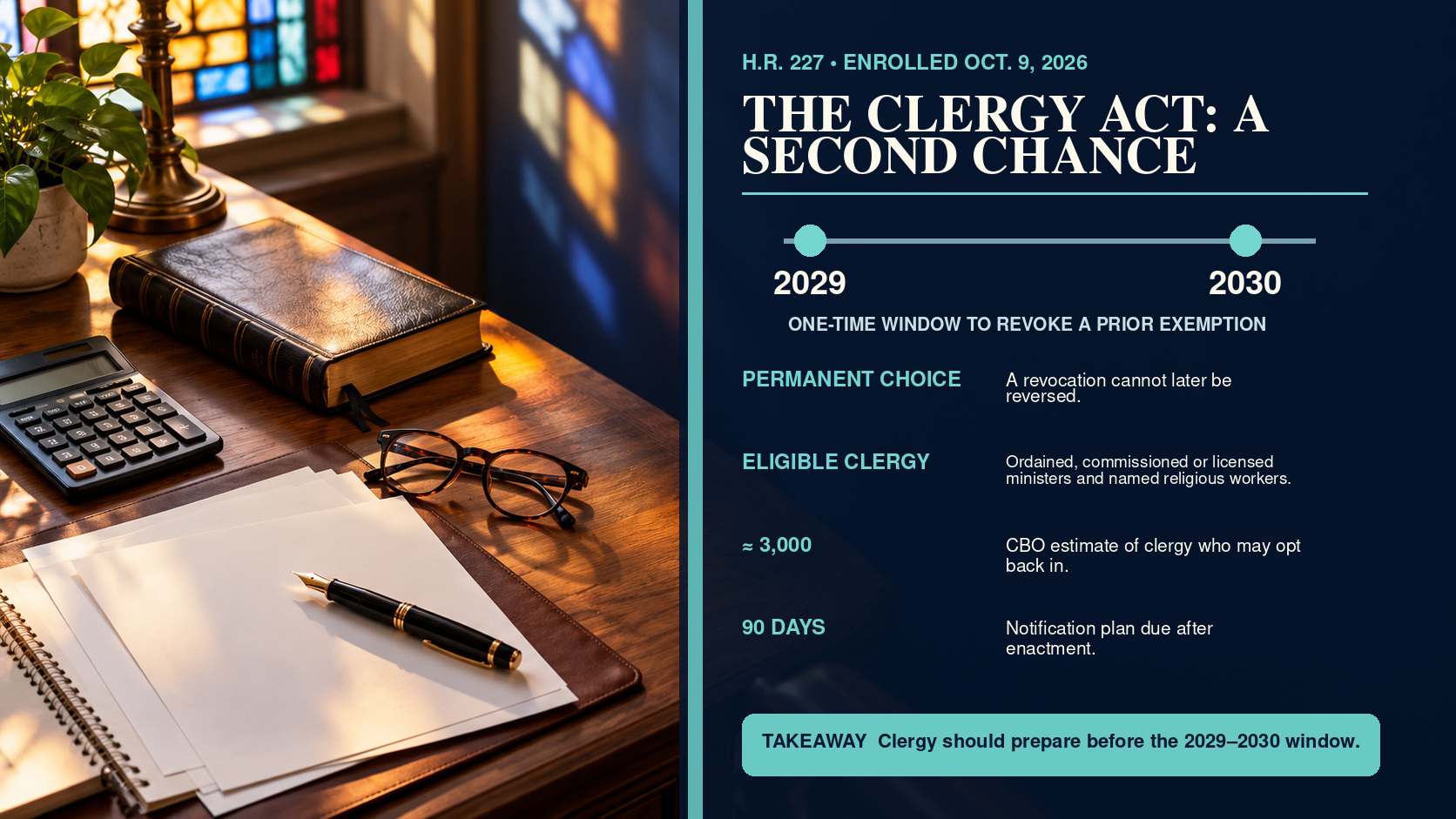
The Clergy Act, H.R. 227, reached enrolled-bill status on October 9, 2026, according to the U.S. Government Publishing Office. An enrolled bill is the final text passed by both chambers and prepared for presidential action; it should not be described as enacted law unless and until that final step occurs. The measure would give certain religious workers a one-time opportunity to revoke an earlier exemption from Social Security self-employment taxes on ministerial earnings. The eligible categories named in the bill are duly ordained, commissioned, or licensed ministers of a church, members of religious orders, and Christian Science practitioners who previously obtained the exemption. A person choosing to return would make the election for either the first or the second taxable year beginning after December 31, 2028—in practical terms, 2029 or 2030. The decision would be permanent: the bill states that someone who revokes the exemption may not later apply for it again. It would also require the Internal Revenue Service, working with the Social Security Administration, to develop a notification plan within 90 days after enactment so potentially eligible people learn about the option. The Congressional Budget Office separately explained that the proposal offers clergy a one-time decision in 2029 or 2030 and estimated that roughly 3,000 people might reverse a prior exemption. Those provisions matter because opting out can affect both present tax obligations and future eligibility for Social Security retirement, disability, and survivor benefits. The enrolled text creates no automatic switch; each eligible person would need to evaluate the election and follow the eventual administrative process if the bill becomes law.
For pastors and church finance teams, the most responsible response is preparation rather than a rushed recommendation. A clergy member's decision depends on age, years of covered earnings, family circumstances, other employment, expected longevity, disability protection, survivor needs, retirement savings, and the cost of resuming self-employment tax on ministerial income. The Social Security system uses a worker's earnings record to determine insured status and benefit amounts, so a minister with limited covered quarters may face a different calculation from one who already has substantial nonministerial earnings. Church compensation practices also matter: housing allowances, accountable reimbursements, retirement contributions, and voluntary tax assistance should be reviewed together rather than as isolated line items. Because the proposed revocation cannot later be undone, leaders should avoid treating it as a simple tax-saving or benefit-maximizing choice. Instead, ministries can identify potentially eligible staff, preserve prior exemption records, encourage each person to obtain an updated Social Security statement, and arrange access to qualified tax and financial professionals familiar with clergy rules. Churches should not presume that an enrolled bill is already operational, and no one should file an election until federal agencies publish authorized procedures following enactment. The CBO estimate of about 3,000 participants also signals that the measure is narrow, not a universal change for all ministers. Even so, the 2029–2030 window would be consequential for the people it reaches. By beginning education now, boards and administrators can help clergy compare projected taxes, retirement income, disability coverage, and survivor protection with enough time for prayerful and informed judgment. The central takeaway is straightforward: monitor the bill's final status, gather records early, and treat the possible election as a permanent retirement-planning decision rather than a temporary payroll adjustment.
Clergy Retirement and Social Security Planning
Christian — Multidenominational
Pastors; Clergy; Church Administrators; Ministry Finance Leaders
U.S. Government Publishing Office

The Pastor's Complete Guide to Personal Financial Planning
H. L. Bert Akin
This 1993 Thomas Nelson paperback addresses pastors' compensation, taxes, insurance, retirement, and investing, making it a practical companion for evaluating an irrevocable Social Security choice.