
Federal Court Order Expands Protection for Illinois Christian Healthcare Conscience
October 8, 2026
An expanded federal court order now prevents Illinois from enforcing its assisted-suicide law against most Catholic healthcare institutions and members of several Christian medical associations while litigation continues. The interim relief matters nationally because it highlights how conscience protections, professional licensing, end-of-life care, and religious healthcare missions can collide when states adopt assisted-suicide regimes.

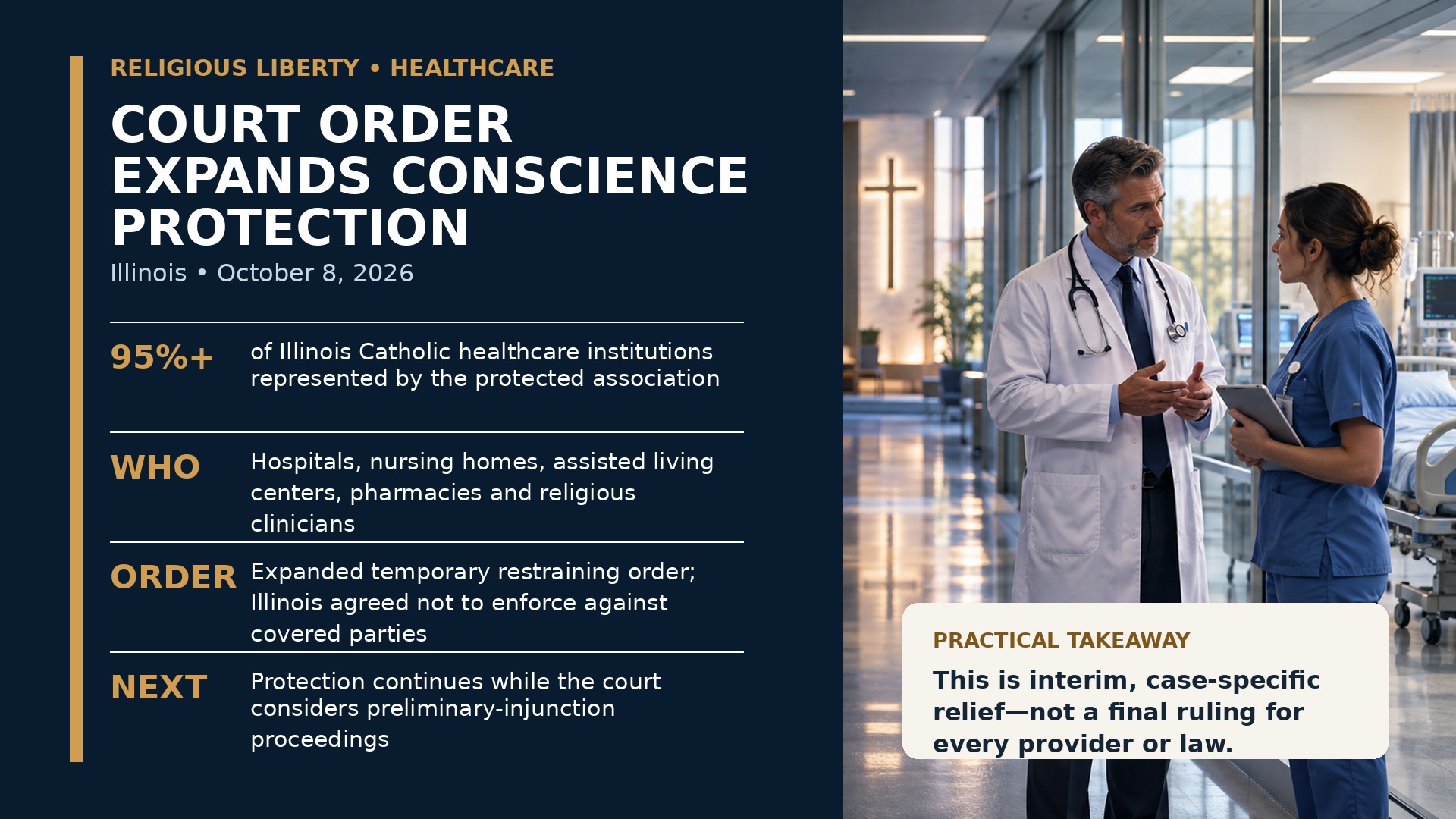
A federal court in Chicago has expanded temporary protection for Catholic institutions and religious healthcare professionals challenging Illinois’ End-of-Life Options for Terminally Ill Patients Act. According to the Thomas More Society’s October 8 report and the stipulated amended temporary restraining order, Illinois agreed that its health and professional regulators will not enforce the law or related conscience-act provisions against covered parties while the case proceeds. The protected groups include the Illinois Catholic Health Association, whose hospitals, nursing homes, assisted-living centers, and pharmacies represent more than 95 percent of Catholic healthcare institutions in the state. The order also reaches members of the Catholic Medical Association, the Christian Medical & Dental Associations, the National Association of Catholic Nurses, and the Catholic Psychotherapy Association, together with the named physicians and institutions and Catholic healthcare entities under the Diocese of Springfield. The lawsuit, Mary Keen Kirchoff, M.D., et al. v. Treto, challenges requirements that objecting professionals describe asserted benefits of assisted suicide, refer requesting patients to willing providers, avoid statements the state may classify as misinformation, and record deaths from prescribed lethal medication as caused by the underlying illness. The challengers say those duties compel religious physicians, nurses, therapists, pharmacies, and institutions to participate in conduct and speech contrary to their commitment to healing and to their understanding of the dignity of human life. U.S. District Judge Franklin U. Valderrama entered the expanded order after an earlier order covered only the original plaintiffs. It is important to describe the development accurately: this is not a final judgment invalidating Illinois’ law, and it does not create a nationwide rule. It is an enlarged, interim court order that preserves the position of specified religious parties while further briefing and related appellate proceedings continue.
The case is nationally relevant because assisted-suicide policies increasingly force lawmakers, courts, medical licensing bodies, patients, and faith-based providers to define the boundary between access requirements and conscience rights. Catholic and evangelical healthcare ministries often understand care for seriously ill people as a calling that includes pain relief, hospice, emotional support, spiritual care, and refusal to intentionally cause death. The Illinois dispute asks whether the state may nevertheless require those ministries and professionals to speak, refer, document, or cooperate in ways they believe make them participants in assisted suicide. For church leaders and Christian clinicians, the prudent response is neither alarmism nor overconfidence. The present order protects identified associations and parties in a specific lawsuit; it does not automatically shelter every facility, employee, or practice, and its duration is tied to the court’s next rulings. Organizations should review the order itself, identify whether they are actually within a protected group, examine governing state and federal law, document their mission and clinical policies consistently, and obtain qualified counsel before relying on the decision. Christian communities can also use the moment to deepen their positive witness in end-of-life care. Conscience claims are strongest morally when paired with excellent palliative medicine, truthful communication, compassionate accompaniment, support for caregivers, and concrete service to people who fear pain, dependence, isolation, or abandonment. Scott Klusendorf’s second edition of The Case for Life is recommended because it equips Christians to reason carefully about human dignity and life ethics while answering objections with clarity and charity. Its paperback edition was published by Crossway in 2023 under ISBN-10 and Amazon ASIN 1433580675. The larger lesson is that legal protection and faithful practice belong together: Christian healthcare institutions must preserve their convictions while demonstrating, in every patient encounter, that refusing to intentionally end life does not mean refusing care.
Christian Medical Conscience and Assisted-Suicide Law
Catholic and Evangelical Christian Healthcare
Christian healthcare professionals, hospital leaders, pastors, religious-liberty advocates, patients, attorneys, and ministry leaders
Thomas More Society

The Case for Life: Equipping Christians to Engage the Culture, Second Edition
Scott Klusendorf
Scott Klusendorf’s 2023 second-edition Crossway paperback develops a Christian case for human dignity and equips readers to discuss life ethics carefully. Amazon ASIN 1433580675 matches the verified 416-page edition and directly supports the conscience and end-of-life questions raised by this case.