
Fifth Circuit Upholds Christian Brothers Automotive’s Faith-Based Franchise Policy
October 8, 2026
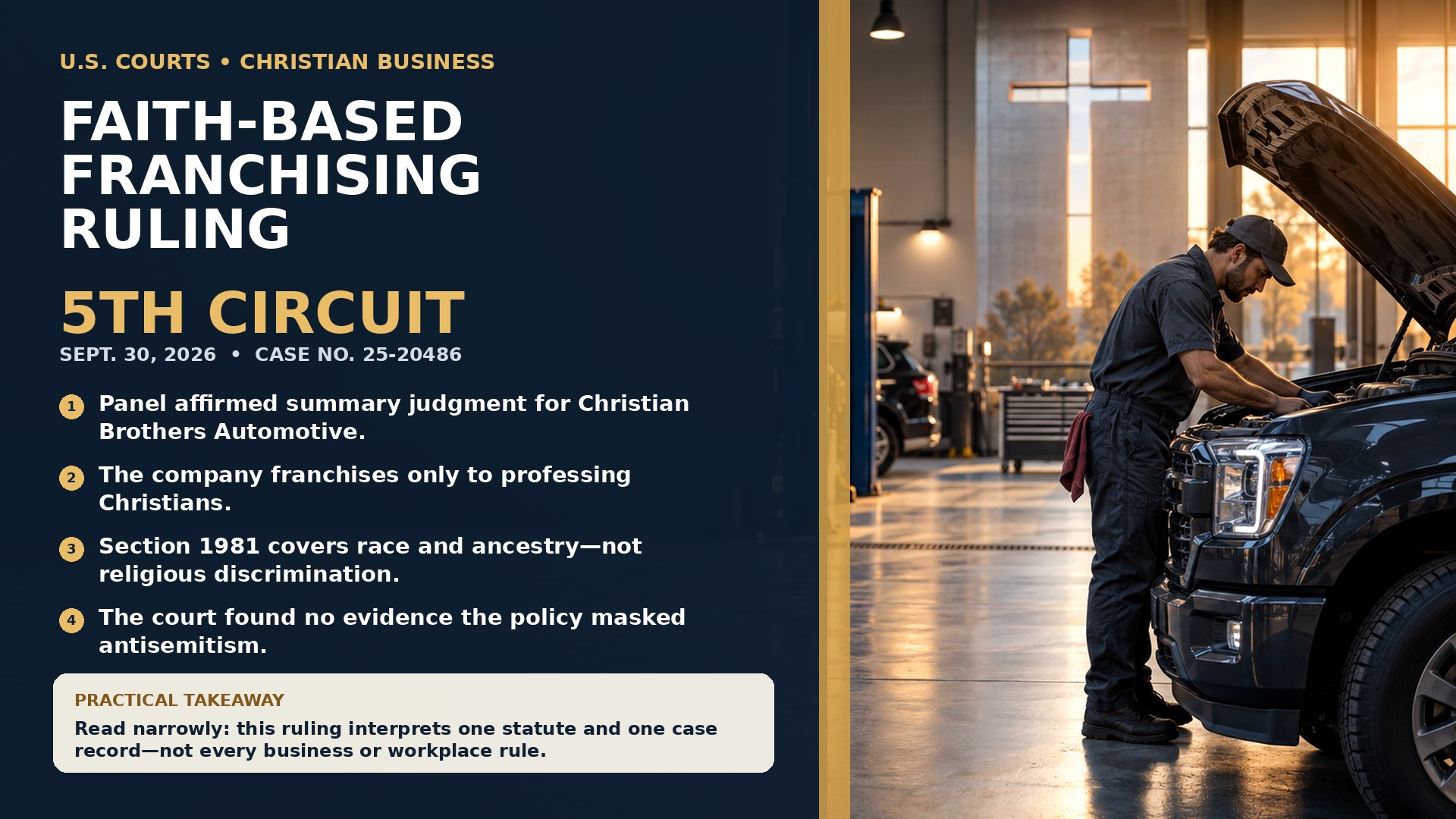
A unanimous Fifth Circuit panel has upheld summary judgment for Christian Brothers Automotive in a dispute over its policy of awarding franchises only to professing Christians. The decision matters to faith-driven entrepreneurs because it distinguishes religious criteria from race or ancestry discrimination under Section 1981, while remaining a narrow ruling tied to one statute and one factual record.

On September 30, 2026, a three-judge panel of the United States Court of Appeals for the Fifth Circuit affirmed summary judgment for Christian Brothers Automotive Corporation in Domanic v. Christian Brothers Automotive Corp., No. 25-20486. The dispute arose after the company declined to advance a prospective franchisee who did not profess Christian faith. Christian Brothers states that its mission is to glorify God by providing ethical and excellent automotive service, and the record described a franchise model limited to professing Christians. The plaintiff, who is Jewish, sued under 42 U.S.C. Section 1981, arguing that the policy constituted race discrimination and that the company used religion as a proxy for ancestry. The panel treated the distinction carefully. It recognized that Section 1981 prohibits discrimination based on race and ancestry, including discrimination that may target Jewish ancestry, but it does not itself prohibit discrimination solely on the basis of religion. Examining the evidence presented in the case, the court found no basis for a reasonable jury to conclude that the profession-of-faith policy concealed antisemitic intent or that Christian Brothers would reject ethnic Jews who profess Christianity. The Christian Post reported the decision on October 8, and the published appellate opinion supplies the controlling details. The decision therefore did not rest on a general declaration that Christian businesses are beyond civil-rights law. It rested on the specific statutory claim, the evidence in the record, and the panel’s conclusion that the challenged requirement was genuinely religious rather than a pretext for racial or ancestral exclusion. Judge Andrew Oldham also wrote separately to question aspects of the framework and to emphasize religious autonomy, highlighting that the legal questions surrounding faith-shaped organizations can extend beyond a single statutory analysis.
For Christian business leaders, the ruling is significant because it illustrates both the reality and the limits of organizing commercial activity around an explicit religious identity. Christian Brothers Automotive has built a national franchise system whose mission language, internal expectations, and franchise-selection policy are presented as expressions of Christian conviction. The Fifth Circuit’s decision allowed the company to prevail against this Section 1981 claim, but prudent readers should resist turning that outcome into an all-purpose rule. Employment law, franchise law, public-accommodation rules, state civil-rights statutes, contractual obligations, and constitutional protections can involve different definitions, exemptions, and fact patterns. The panel did not announce that every religious requirement imposed by every company is lawful, nor did it decide every First Amendment question that might arise in another dispute. What it did provide is a concrete example of a court separating a religion-based criterion from unlawful race or ancestry discrimination when the evidentiary record did not support the alleged pretext. Churches and ministries that counsel Christian entrepreneurs can use the case as a prompt for disciplined governance. Mission statements should be matched by consistent practices, accurate documentation, clear communication, and qualified legal advice before policies are adopted or enforced. Leaders should also consider the Christian witness conveyed by their treatment of applicants, employees, franchisees, customers, and neighbors, especially those who do not share their beliefs. A defensible policy is not automatically a wise policy in every setting, and legal permission never replaces biblical obligations of truthfulness, justice, neighbor love, and integrity. The most constructive takeaway is therefore twofold: faith-driven enterprises may articulate a coherent Christian identity, and they should do so transparently, consistently, and with careful attention to the precise laws that govern each relationship. Reading the opinion itself, rather than relying on a headline alone, helps keep the decision in its proper scope.
Faith-Based Franchising and Religious Business Identity
Christian — Multidenominational
Christian business owners, entrepreneurs, ministry leaders, attorneys, human-resources professionals, and consumers
The Christian Post

Faith Driven Entrepreneur: What It Takes to Step Into Your Purpose and Pursue Your God-Given Call to Create
Henry Kaestner, J.D. Greear, and Chip Ingram
This first-edition Tyndale hardcover connects Christian conviction with entrepreneurship, purpose, leadership, and marketplace stewardship, making it a practical companion for readers considering how a business can embody an explicit faith identity.