
IMB Innovation Leader Honored for Biblically Grounded AI in Missions
September 28, 2026
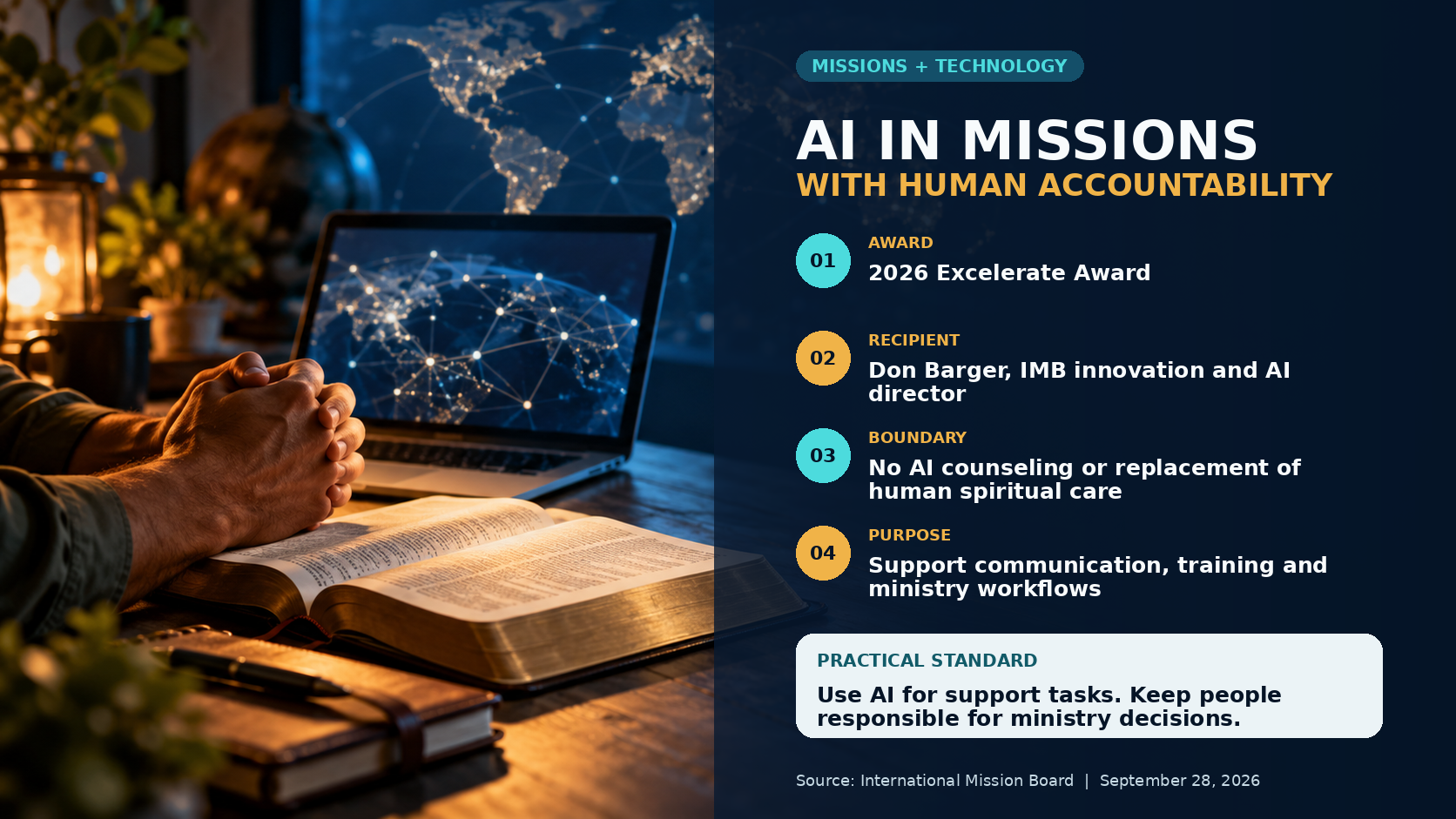
The International Mission Board’s Don Barger received the 2026 Excelerate Award for innovative leadership in missions. His work emphasizes using artificial intelligence for communication, training, and support while keeping people responsible for spiritual care and ministry decisions, giving churches a thoughtful model for adopting new tools without surrendering biblical accountability.

Don Barger, director of innovation and artificial intelligence for the International Mission Board, received the 2026 Excelerate Award during the Missio Nexus Mission Leaders Conference in Orlando on September 24. The IMB reported the honor on September 28, describing it as recognition of leadership and creativity that advance the work of missions through innovation. Barger’s public explanation of the work is especially notable because it places firm ministry boundaries around the technology. He said artificial intelligence is not being used to counsel people or replace human spiritual care. Instead, the tools are directed toward support functions that help missionaries and ministry teams communicate, train, organize knowledge, and remove practical barriers. People remain responsible for ministry decisions and relationships. That distinction gives the award broader importance than a celebration of technical achievement. It presents a visible example of a Christian missions organization evaluating artificial intelligence according to its purpose, limits, and effect on people rather than treating novelty as a sufficient reason for adoption. Barger has also developed faithbot.tools as a resource for evangelical Christians exploring the technology. The IMB’s account connects his work to the needs of missionaries who operate across languages, cultures, distances, and demanding ministry settings. Used carefully, support tools offer faster access to information, more efficient preparation, and better communication across teams. The organization’s stated boundaries are equally important. Gospel ministry depends on embodied relationships, biblical wisdom, prayer, local knowledge, and accountable human judgment. The award therefore highlights a model in which technical experimentation remains subordinate to the church’s mission and to the dignity of the people being served.
For pastors and mission leaders, the most practical question is not whether artificial intelligence is entirely good or entirely harmful. The better question is which tasks belong to software and which responsibilities belong to mature Christian people. The IMB example provides a useful starting framework. Administrative support, translation assistance, document search, training preparation, and routine communication are different in kind from pastoral counsel, evangelistic relationships, spiritual discernment, discipline, and decisions that directly affect a person’s welfare. Churches exploring these tools should name those distinctions before adopting a platform. They should also establish human review for generated material, protect confidential information, verify facts, respect copyright, and document who is accountable for a final decision. Mission settings add further concerns because language and cultural context influence meaning. A fluent sentence is not necessarily a faithful translation, and a quick summary is not necessarily an accurate reading of a local situation. Teams need qualified people who understand the community, the Scripture, and the ministry’s obligations. The Excelerate Award brings attention to innovation, but the enduring value of Barger’s approach lies in its restraint. Technology serves the mission when it reduces friction and gives people more time for prayer, presence, teaching, listening, and care. It distorts the mission when convenience becomes a substitute for those responsibilities. Christian organizations across the United States are already facing decisions about staff use, volunteer training, content creation, and data stewardship. This story offers them a constructive pattern: begin with a biblical understanding of people and ministry, define a limited purpose for each tool, test outputs carefully, and keep accountable humans in authority. Innovation then becomes disciplined stewardship rather than a race to imitate the surrounding culture.
Missions Technology and Artificial Intelligence
Southern Baptist; Evangelical
Mission Leaders; Pastors; Church Technology Leaders; Ministry Teams
International Mission Board

The Age of AI: Artificial Intelligence and the Future of Humanity
Jason Thacker
Jason Thacker’s hardcover book offers a Christian ethical framework for artificial intelligence, directly complementing the IMB emphasis on human accountability and biblically grounded use. ASIN 0310357640.