
Leavell College Launches Tentmaker Degree Pathway for Bivocational Ministry
October 7, 2026
Leavell College has announced a new Tentmaker Degree Pathway that joins theological formation with vocational preparation for bivocational pastors, church planters, and missionaries. Approved October 7, the plan includes a new Bachelor of Science, four majors, transferable vocational study, and an accelerated BS-to-MDiv option—an important response to churches and mission fields where ministry leaders also need sustainable marketplace work.

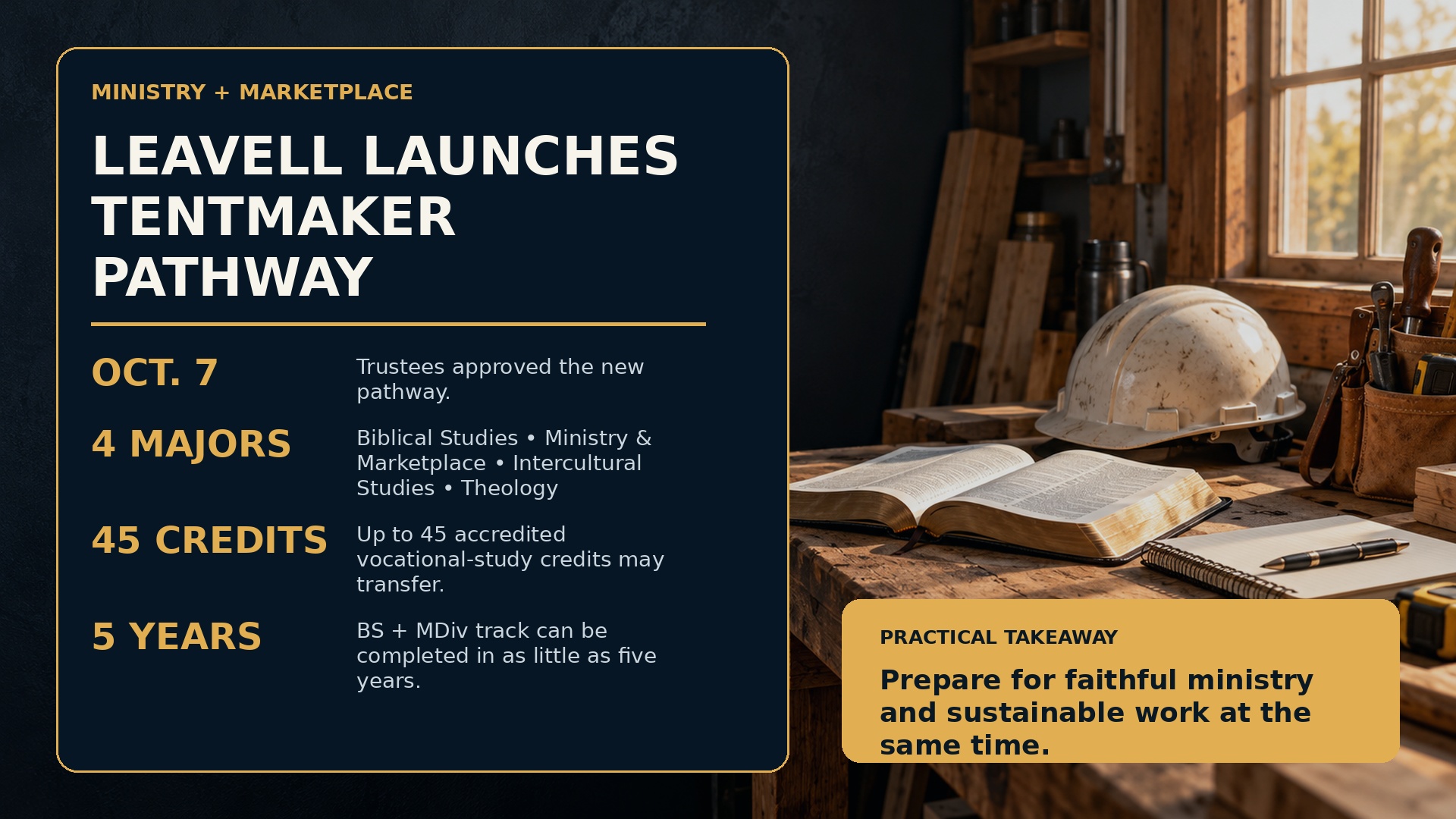
Leavell College at New Orleans Baptist Theological Seminary announced a Tentmaker Degree Pathway on October 7, 2026, after approval by the seminary’s trustees. The pathway is built for students who believe they are called to Christian ministry but expect to serve in bivocational or covocational settings, where pastoral, church-planting, or missionary responsibilities are combined with paid work outside a ministry position. According to the school’s announcement, students may take newly offered business and leadership courses or transfer as many as 45 credit hours of accredited vocational study. The plan introduces a Bachelor of Science with four majors—Biblical Studies, Ministry and Marketplace, Intercultural Studies, and Theology—along with a Bachelor of Arts major in Business and Leadership. It also creates a BS-to-MDiv track that the college says can allow a student to complete both degrees in as little as five years. President Jamie Dew connected the design to repeated requests from churches, local associations, and state conventions for preparation that fits the financial and vocational realities facing many future pastors. He also pointed to church planters and International Mission Board personnel who may need a job or professional platform to support their service or enter a ministry context. Dean Greg Wilton described the model through the New Testament example of Paul working as a tentmaker in Acts 18. The institution’s stated goal is not to reduce theological preparation, but to combine biblical, ministerial, and vocational training within a coherent undergraduate pathway that can serve students headed toward local church ministry, church planting, or cross-cultural mission.
The development matters beyond one college because it addresses a practical question facing congregations and ministry candidates across the United States: how can leaders receive serious Christian formation while also preparing for the economic realities of service? Many small churches, new congregations, and specialized mission settings cannot support a full-time salary, yet they still need pastors and ministry workers who can interpret Scripture responsibly, shepherd people, organize ministry, and participate in their communities. A pathway that recognizes accredited vocational study can make room for students whose marketplace skills are not a distraction from calling but part of how that calling may be sustained. The four-major structure also lets students connect theological study to distinct directions, including intercultural ministry and work at the intersection of church and marketplace. The accelerated graduate option could further reduce the time between undergraduate entry and advanced theological preparation, though prospective students should still examine admissions rules, transfer evaluations, costs, delivery formats, and denominational requirements before making a decision. Churches can use the announcement as an invitation to think more intentionally about bivocational ministry. That means providing realistic expectations, shared leadership, mentoring, and congregational support rather than assuming a bivocational pastor can carry two full-time workloads indefinitely. It also means honoring ordinary work as a setting for Christian witness, relationships, and service. Leavell College says it has begun conversations with local community colleges about future partnerships and intends the transfer framework to accept eligible vocational credits from other accredited institutions. If implemented carefully, the model may help ministry students prepare for both faithful church leadership and credible participation in the working world, giving congregations another route for developing leaders without separating theological depth from practical sustainability.
Bivocational Ministry and Marketplace Preparation
Evangelical Protestant — Southern Baptist
Prospective ministry students, bivocational pastors, church planters, missionaries, and church leaders
New Orleans Baptist Theological Seminary

The Tentmaking Pastor: The Joy of Bivocational Ministry
Dennis W. Bickers
This first-edition Baker book draws on Dennis W. Bickers’s experience in bivocational pastoral ministry and directly complements the pathway’s effort to unite church leadership with sustainable outside work.