
Lifeway Study Finds Longer Sermons Still Match Churchgoer Preferences
October 6, 2026
A new Lifeway Research study finds that U.S. Protestant pastors are preaching somewhat longer sermons while most churchgoers remain comfortable with the time they receive. The findings matter because they move the conversation beyond a single ideal length and invite pastors to weigh biblical substance, congregational context, and listener expectations together.
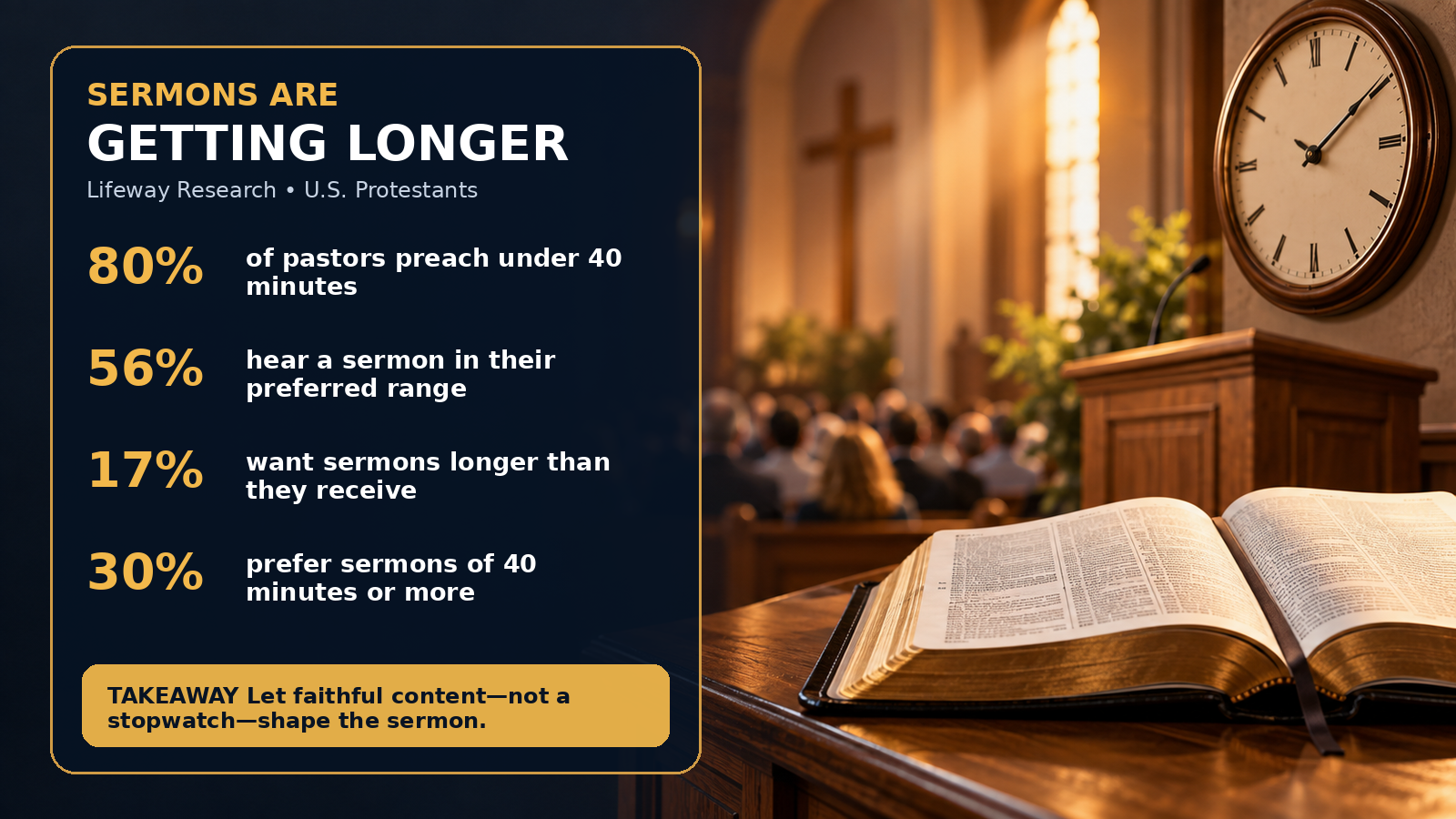
Lifeway Research’s new nationwide look at sermon length offers a useful correction to the assumption that contemporary churchgoers uniformly want preaching compressed into ever-shorter segments. Baptist Press reported on October 6, 2026, that four in five U.S. Protestant pastors, or 80 percent, say their sermons remain under 40 minutes, while 52 percent finish in less than 30 minutes. The distribution is broad rather than centered on one universal standard: 10 percent of pastors preach for less than 15 minutes, 21 percent for 15 to under 20 minutes, another 21 percent for 20 to under 30 minutes, and smaller groups continue beyond 40 minutes. The study also found meaningful differences between traditions. Mainline pastors were more likely than evangelical pastors to preach for less than 20 minutes, while evangelical pastors were more likely to land between 30 and 50 minutes. That variation matters because sermon length is shaped by worship patterns, congregational history, teaching expectations, and the place preaching occupies within a church’s full service. The report does not argue that longer is automatically better. Instead, it shows that many pastors have gradually extended their messages without creating widespread dissatisfaction. For churches, the most important news is that the pulpit and pew are not as far apart as popular commentary sometimes suggests. Congregations generally recognize the preaching culture of the churches they attend, and most pastors are serving within a range their listeners already understand. The research therefore gives pastors a clearer factual starting point for evaluating their own practice without chasing assumptions based on short-form media trends.
Churchgoer responses reinforce that conclusion while also warning leaders not to treat any national average as a command. Fifty-six percent say the sermon they hear already falls within their preferred range. One quarter would like a shorter message, but 17 percent would prefer their pastor to preach longer, up from 13 percent in 2019. Preferences are spread across the clock: 41 percent favor a sermon under 30 minutes, 26 percent prefer 30 to 40 minutes, and 30 percent want at least 40 minutes, including 11 percent who say a sermon of an hour or more is ideal. Those figures should encourage thoughtful pastoral discernment. A church cannot measure faithfulness by minutes alone, yet time is still a stewardship issue. A carefully prepared 25-minute sermon can open Scripture with clarity and application; a 50-minute sermon can do the same when the congregation is formed to listen and the preacher sustains focus. The practical task is to ask whether a sermon explains the biblical text, proclaims Christ, addresses real people, and uses each minute purposefully. Leaders can also compare survey data with local evidence through listening sessions, elder feedback, newcomer conversations, and honest review of sermon recordings. The study’s deeper implication is pastoral rather than technical: congregations are often willing to give sustained attention to biblical preaching when they trust the preacher and find the message spiritually substantial. Instead of letting a stopwatch dictate the sermon, churches can pursue a healthier partnership in which pastors prepare diligently and listeners communicate constructively. That approach honors both the authority of Scripture and the real people gathered to hear it.
Preaching Practice and Congregational Expectations
Protestant / Evangelical
Pastors, Preachers, Church Leaders, and Congregations
Baptist Press / Lifeway Research

Preaching: Communicating Faith in an Age of Skepticism
Timothy Keller
Keller’s practical, gospel-centered guide helps pastors think beyond duration and focus on faithful biblical communication, cultural understanding, and application.