
OCC Review Flags Religious-Belief Risks in Major-Bank Debanking Policies
October 14, 2026
A new federal review says all nine of the nation’s largest national banks maintained policies that could influence access to financial services based on political or religious beliefs. The findings matter to churches, ministries, and Christian nonprofits because banking access affects payroll, giving, missions, and daily service—and because vague reputation-risk standards can leave lawful faith-based organizations without clear answers.

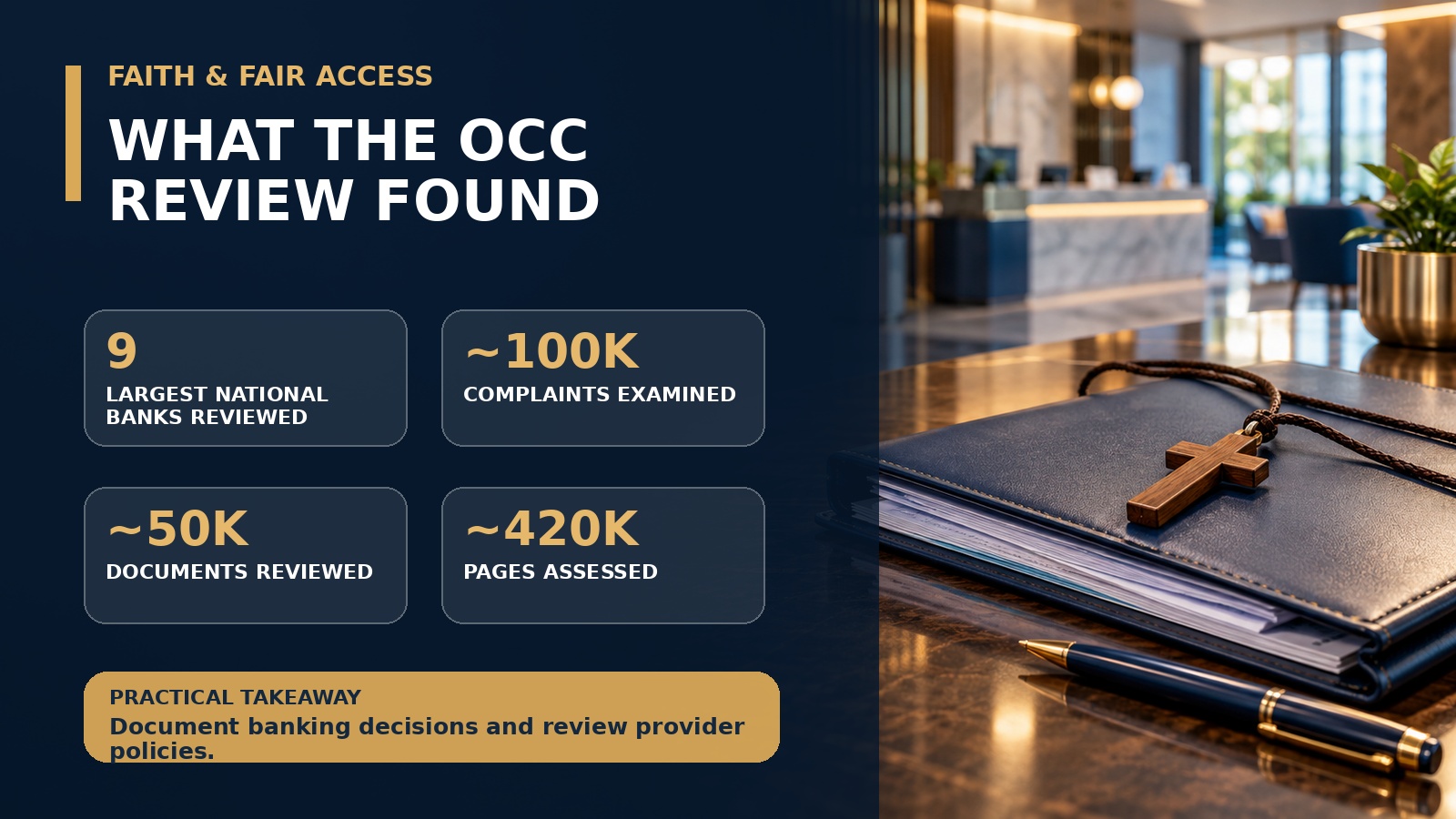
The Office of the Comptroller of the Currency released a report on October 14, 2026, after reviewing the debanking activities of nine large national banks: JPMorgan Chase, Bank of America, Citibank, Wells Fargo, U.S. Bank, Capital One, PNC, TD, and BMO. The agency said that each bank had policies in place at some point between 2020 and September 2025 that may have influenced decisions to deny or limit financial services because of customers’ political or religious beliefs or because they participated in lawful but disfavored lines of business. The review was unusually broad. According to the OCC, examiners considered nearly 100,000 complaints and approximately 50,000 bank documents totaling about 420,000 pages. One recurring concern was the use of broad reputation-risk language without sufficiently clear, objective, risk-based criteria. That kind of discretion matters to Christian churches, ministries, schools, publishers, pregnancy-help organizations, and missions groups because basic banking relationships are infrastructure, not a luxury. A canceled account or delayed transaction can disrupt payroll, recurring donations, vendor payments, benevolence, and overseas ministry support. The report does not establish that every challenged bank decision was made solely because of religion, and responsible readers should not claim more than the OCC found. It does establish that policies capable of allowing viewpoint-based or belief-based treatment existed across all nine institutions studied. That nationwide pattern is significant because it moves the conversation beyond one disputed anecdote and toward questions of governance, documentation, transparency, and consistent access for lawful organizations. That concern extends to ministries across the country.
For Christian leaders, the most useful response is careful stewardship rather than alarm. Boards and finance teams can begin by documenting account agreements, adverse decisions, unexplained holds, requests for additional information, and every communication with a financial institution. Ministries should know which officers are authorized to speak for the organization, keep formation documents and charitable registrations current, and maintain ordinary controls that demonstrate responsible handling of donations. Those practices do not concede that faith-based groups deserve extra scrutiny; they help distinguish legitimate compliance questions from inconsistent or viewpoint-driven treatment. Leaders may also want to ask banks how reputation-risk decisions are defined, reviewed, appealed, and communicated, and whether written policies protect lawful religious organizations from discrimination based on belief. The OCC said its work is continuing and that it is considering further changes, so churches and nonprofits should follow agency updates instead of assuming the October report is the last word. The Christian concern is larger than protecting a favored constituency. Equal access to routine financial services helps preserve the ability of congregations and ministries to serve neighbors, support missionaries, employ staff, educate students, and participate in civic life without surrendering their convictions. At the same time, Christian witness requires accuracy: the report should not be turned into a claim that every bank or employee acted with hostility. The better lesson is that vague standards can create room for unfairness, and institutions should replace ambiguity with objective rules, clear explanations, meaningful review, and equal treatment. That approach joins religious liberty with prudence, truthfulness, and a practical commitment to the common good.
Faith-Based Organizations and Fair Access to Banking
All Christian Traditions
Church Leaders, Ministry Executives, Christian Nonprofits, Religious Liberty Advocates
Office of the Comptroller of the Currency

Free to Believe: The Battle Over Religious Liberty in America
Luke Goodrich
Luke Goodrich explains why religious freedom matters and how Christians can respond constructively when ordinary participation in public life is burdened because of belief—an apt framework for evaluating fair access to essential banking services.