
PayPal Revises U.S. Policies to Strengthen Protection for Religious and Political Viewpoints
November 5, 2026
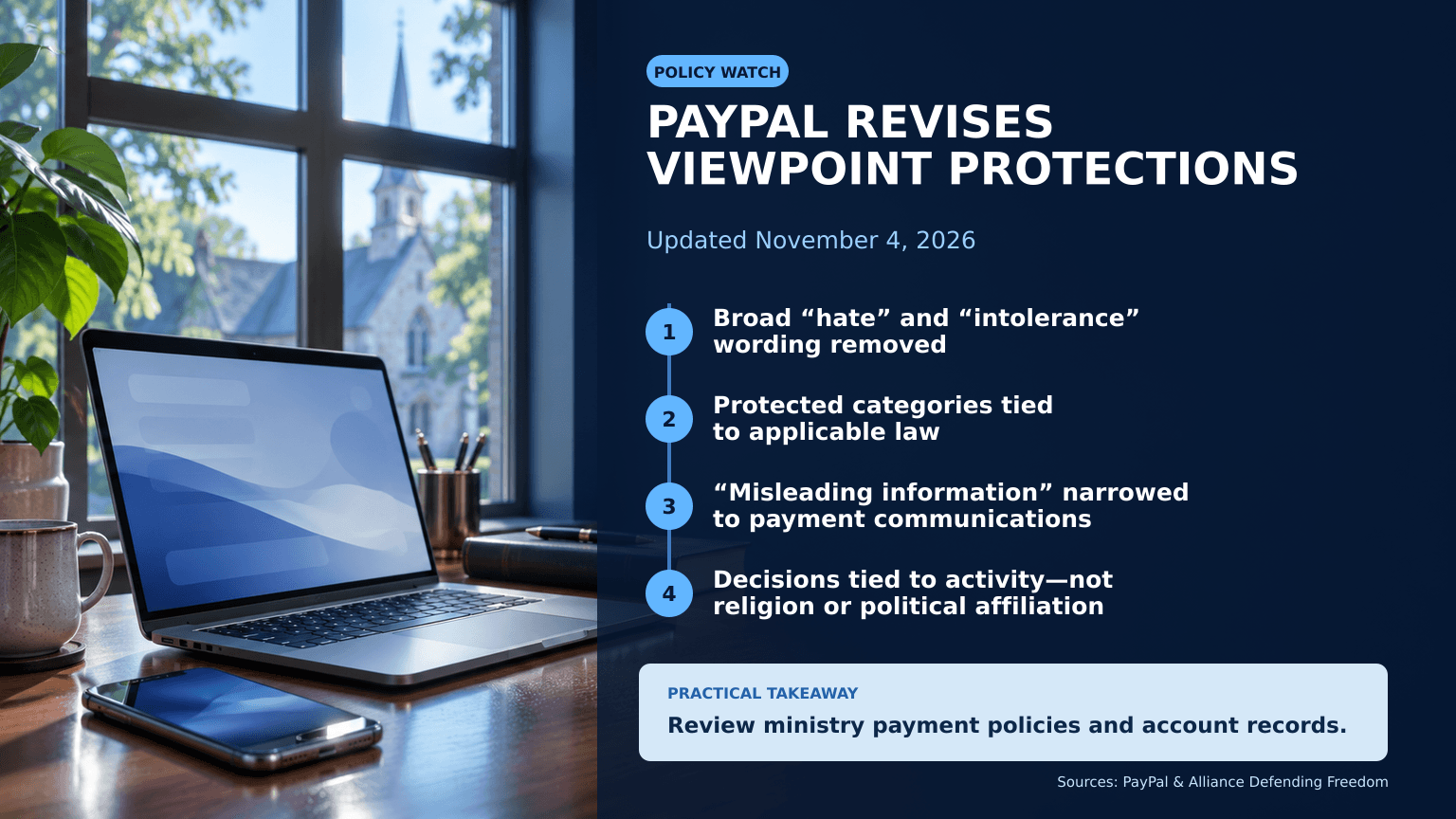
PayPal has revised its U.S. acceptable-use language and published a viewpoint-neutrality assurance after religious-liberty advocates challenged broad policy terms. The changes matter to churches, ministries, and Christian organizations that rely on payment platforms because they clarify that account decisions should rest on customer activity, not religious or political affiliation.

PayPal updated its United States Acceptable Use Policy on November 4, 2026, making several changes that are significant for churches, ministries, nonprofit organizations, and other customers concerned about viewpoint-based financial access. Alliance Defending Freedom described the revisions in a November 5 announcement, and the central provisions are also visible in PayPalâs own policy and frequently asked questions. The company removed broad references to âhateâ and âintoleranceâ from the policy provision governing certain prohibited activities and instead connected the prohibition to categories protected under applicable law. PayPal also narrowed language concerning misleading information so that it applies to communications made through PayPal in connection with a payment transaction, rather than functioning as a sweeping rule about expression generally. In a related FAQ, PayPal states that decisions to restrict an account are based on a customerâs activities and not on characteristics or affiliations such as religion or political affiliation. That assurance provides a clearer standard for organizations whose biblical convictions or public advocacy may be unpopular but are lawful. Alliance Defending Freedom said it withdrew its objection to the Federal Deposit Insurance Corporation application for PayPal Bank after PayPal notified the organization of the policy changes. The development should be reported with appropriate precision: it is a documented revision of governing language and a public clarification of account-decision principles, not a guarantee that every future dispute will disappear or that every platform question has been resolved. Still, written policies matter because they shape internal enforcement, customer expectations, appeals, and regulatory review. For ministries that use online platforms to accept gifts, sell resources, register attendees, or receive program fees, clear and viewpoint-neutral terms are part of dependable access to the ordinary financial tools required for service.
The immediate practical response for Christian organizations is careful administration rather than alarm. A church treasurer, ministry executive, or Christian business owner should read the current PayPal policy directly, preserve copies of account agreements and important correspondence, keep the organizationâs legal name and governing documents current, and maintain accurate descriptions of products, donations, and activities. Teams should also identify who has authority to respond if an account is limited and should retain records that show compliance with payment, fraud-prevention, and consumer-protection rules. Viewpoint neutrality does not remove the obligation to follow lawful transaction standards, nor does it make operational resilience unnecessary. Ministries may still benefit from reviewing backup donation methods and ensuring that no single processor is the only path for essential giving or registration. At the same time, the revisions are noteworthy for religious liberty because access to common financial services increasingly affects whether lawful organizations can participate in public and economic life. A policy that focuses enforcement on conduct and applicable law is more predictable than one built around undefined ideological terms. The change also illustrates why organizations should distinguish primary documentation from advocacy commentary: Alliance Defending Freedom provides the legal and religious-liberty context, while PayPalâs own updated policy and FAQ establish the operative language. Christian leaders can welcome a clearer standard without overstating what it proves, and they can use the moment to strengthen governance across all payment relationships. A concise board review of platform policies, appeal procedures, account ownership, and contingency plans would turn a national policy development into responsible local action. The Christian concern is not special immunity from neutral rules; it is equal access under rules that do not penalize a lawful ministry simply because of its religious identity or political viewpoint.
Religious Liberty and Financial Access
Evangelical / Non-Denominational
Church leaders, ministries, nonprofit administrators, and Christian business owners
Alliance Defending Freedom
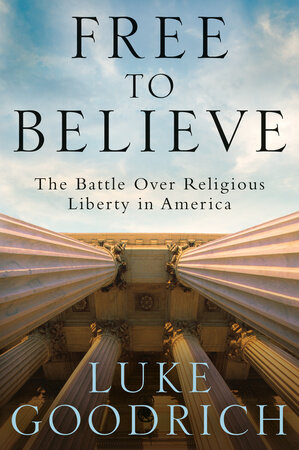
Free to Believe: The Battle Over Religious Liberty in America
Luke Goodrich
Luke Goodrich explains the legal and cultural pressures surrounding religious liberty, giving church and ministry leaders a useful framework for understanding why neutral access to financial services matters.