
Religious Education Fairness Act Seeks to Protect Aid for Ministry Students
September 29, 2026
A new Senate bill would protect eligible theology, religious-vocations and religious-studies programs from federal aid penalties tied to graduates’ earnings. The proposal matters to ministry students and Christian schools because pastors, missionaries and other service-oriented graduates may earn less than peers in commercial fields even when their education fulfills an essential calling.

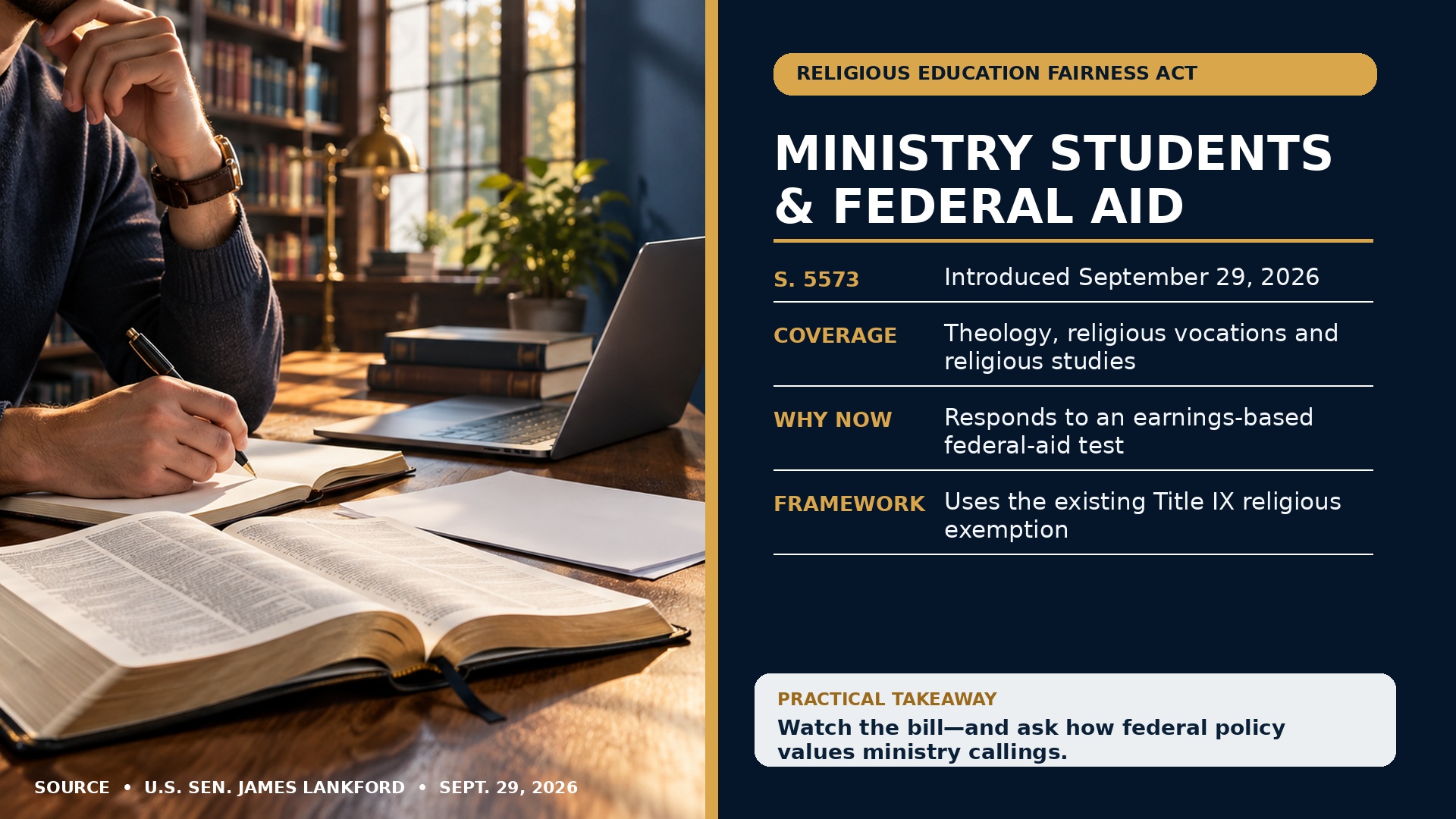
U.S. Senators James Lankford of Oklahoma and Ted Cruz of Texas introduced the Religious Education Fairness Act on September 29, 2026, presenting it as a focused response to federal higher-education accountability rules that can place student aid at risk when graduates’ earnings fall below prescribed measures. The bill, identified in the Senate as S. 5573, would cover qualifying programs classified as Theology and Religious Vocations or Philosophy and Religious Studies at eligible religious institutions. Its immediate concern is the earnings-based accountability measure commonly described as the “Do No Harm” provision. That policy uses post-graduation earnings information to assess whether programs remain eligible for federal Direct Loans. A related Department of Education rule finalized July 1, 2026, also created an administrative-capability requirement with potential consequences for other Title IV assistance, including Pell Grants and Federal Work-Study. Ministry preparation does not fit neatly into an earnings comparison because many graduates deliberately enter churches, missions, chaplaincy, nonprofit service or other vocations where compensation is not the primary measure of value. The legislation therefore seeks to prevent the federal government from treating lower earnings as evidence that religious education failed its students. Its approach is narrow rather than universal: it identifies eligible religious schools through the existing Title IX religious-exemption framework and protects the specified programs from the Direct Loan earnings test and the associated administrative-capability standard. The measure has been introduced, not enacted, so its practical effect will depend on congressional action and any later implementation. Students should therefore treat the announcement as a legislative development rather than a current change to aid eligibility.
For Christian colleges, seminaries and families discerning a call to ministry, the proposal highlights a longstanding tension between economic accountability and religious vocation. Public safeguards for student aid can serve an important purpose, but a salary-only standard may undervalue work that churches and communities regard as service rather than a route to high income. A pastor serving a rural congregation, a missionary supported by donors or a ministry worker in a small nonprofit may be carrying significant responsibility while earning less than graduates in commercial professions. The bill’s sponsors argue that a program should not lose access to federal assistance merely because its graduates choose that kind of work. The coalition listed in support of the measure spans several parts of the religious-education landscape, including Alliance Defending Freedom, the Association for Biblical Higher Education, the Council for Christian Colleges & Universities, the United States Conference of Catholic Bishops, the Transnational Association of Christian Colleges & Schools, the International Alliance for Christian Education, the International Association of Baptist Colleges and Universities and the Orthodox Union. That breadth does not settle every policy question, but it shows that the issue reaches beyond one denomination. Churches and schools should now follow the bill’s progress, explain clearly that it remains proposed legislation, and help students understand both the availability and the responsibilities of federal aid. Christian institutions can also use the debate as an opportunity to report outcomes honestly, strengthen financial counseling and describe ministry success with measures that include faithful service, preparation, placement and long-term sustainability—not only income. The central public question is whether accountability can protect students without allowing an earnings formula to become a judgment on the worth of a religious calling.
Christian Higher Education and Religious Vocations
Christian Higher Education; Evangelical; Catholic; Protestant
Seminary Students; Ministry Candidates; Christian Educators; Church Leaders; Religious Liberty Advocates
Office of U.S. Senator James Lankford

The Call: Finding and Fulfilling God's Purpose For Your Life
Os Guinness
Verified expanded and revised anniversary paperback edition, ASIN 0785220070. Os Guinness examines Christian calling beyond career status or income, making the book a fitting companion to a policy debate about how ministry vocations are valued.