
Overwhelmed
2 Corinthians 10:5 NIV
We demolish arguments and every pretension that sets itself up against the knowledge of God, and we take captive every thought to make it obedient to Christ.
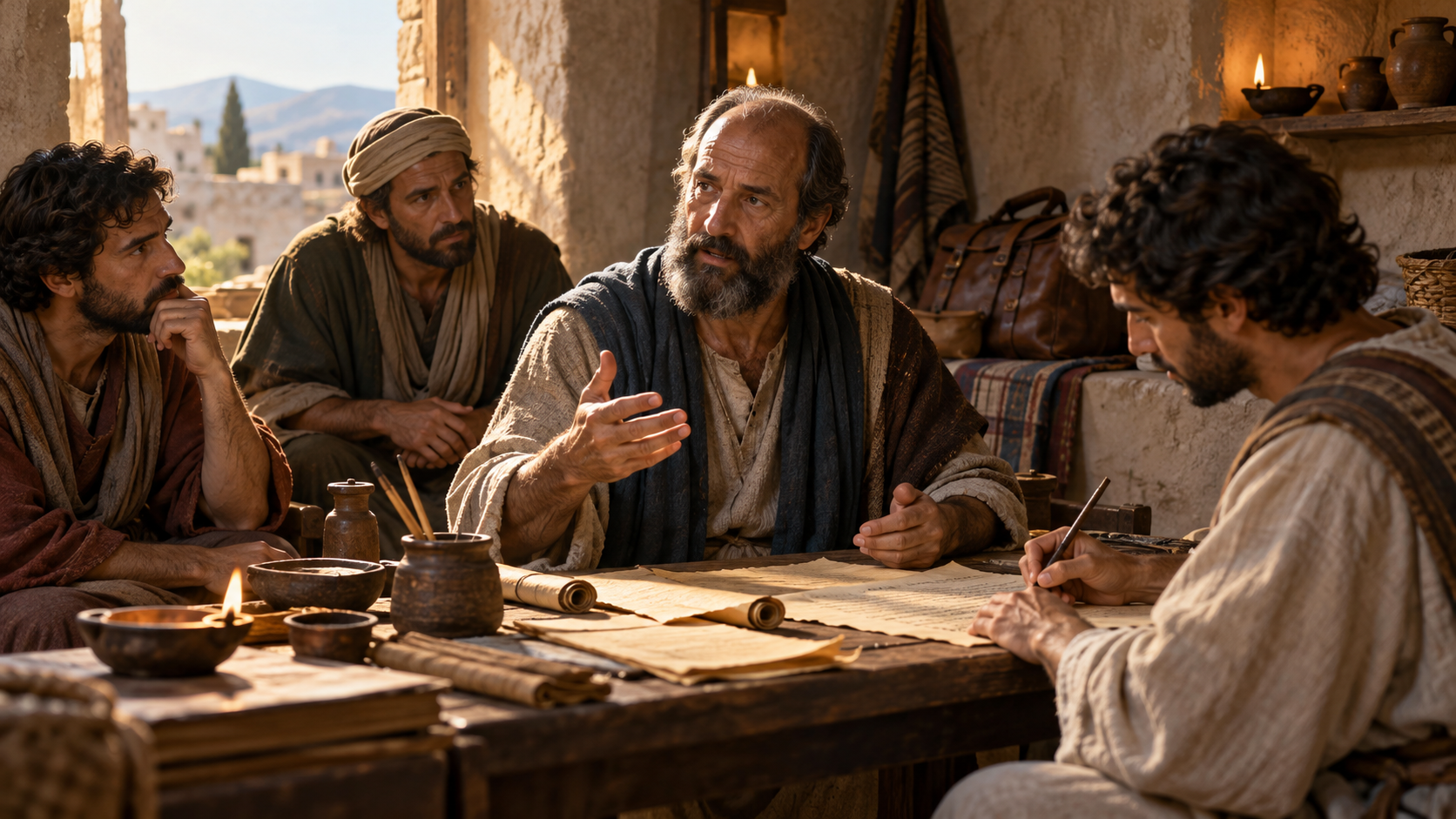
A man can finish the workday while an argument is still running in his head. A criticism becomes proof that he is failing, a delay starts to feel like disaster, or an old resentment quietly prepares the next conversation. Paul’s words in 2 Corinthians 10:5 are not a call to deny emotion or force cheerful thoughts. They invite us to notice the ideas competing with God’s truth, bring them into the light, and submit our thinking to Christ. The mind is not mastered by panic, but by patient, honest obedience.
Scripture Explained
Some battles continue long after the room grows quiet. A man replays a remark from his supervisor, imagines the worst outcome for his family, or builds a case against someone who disappointed him. Thoughts can feel private and harmless, yet they shape the tone of a marriage, the courage brought to work, and the choices made when nobody is watching. Paul gives language for taking the inner life seriously without treating every passing thought as a crisis.
Second Corinthians 10 begins a section in which Paul answers critics who questioned his authority and judged him by outward standards. They accused him of being timid in person but forceful in his letters. Paul refuses to fight for credibility through intimidation, manipulation, or self-promotion. He speaks instead of divine power that tears down strongholds, arguments, and proud claims raised against the knowledge of God. The immediate conflict is public and theological, not merely an individual struggle with negative thinking.
That context matters because the “strongholds” in Paul’s picture are not mysterious feelings that can be defeated by confidence alone. They are entrenched patterns of reasoning and pride that resist what God has made known. His military language describes a conflict of allegiance: human ideas are not allowed to sit above Christ as final judge. The gospel exposes every claim that makes self, culture, success, fear, or resentment more authoritative than the Lord.
Taking a thought captive does not mean pretending painful emotions are unreal or blaming yourself whenever an unwanted thought appears. Scripture does not say that temptation, grief, trauma, or intrusive thoughts vanish through sheer mental effort. Responsible application begins by bringing our interpretations under Christ’s rule. A thought is examined, not automatically believed; compared with God’s truth, not merely replaced with optimism; and directed toward an obedient response. Some struggles also call for pastoral care, counseling, or medical support alongside prayer.
Think About This
The thoughts with the greatest influence are often the ones a man no longer notices. “If I am not in control, everything will fall apart.” “If he respected me, he would never question me.” “Because I failed once, I will fail again.” Such conclusions can hide beneath hard work, anger, withdrawal, or constant planning. They may contain a piece of truth, but then stretch it into a verdict that leaves no room for God’s character, another person’s perspective, or the possibility of repentance and change.
Christian thought discipline is different from positive thinking. The goal is not to manufacture a pleasant mood or insist that every situation will turn out as we prefer. Christ himself is the standard. His words correct exaggeration, pride, despair, and self-protection while making room for lament, caution, and honest limits. A thought becomes obedient when it leads us toward truthfulness, love, courage, repentance, patience, and trust rather than feeding the impulses that already control us.
What Should I Do
A useful place to begin is one recurring thought, rather than an attempt to repair your whole mind at once. Write the sentence exactly as it appears when pressure rises, then note what usually triggers it and what it produces in your behavior. A thought that repeatedly leads to contempt, panic, secrecy, or hopelessness deserves careful attention. Naming it creates enough distance to ask whether it is a fact, an interpretation, a fear, or an accusation.
That sentence then belongs beside Scripture read in context. Ask what it assumes about God, about you, and about the person or situation involved. A truthful response does not need to exaggerate in the opposite direction. “I cannot control this outcome, but I can obey Christ in the next decision” is more faithful than either catastrophe or denial. Return to that truth in prayer, and choose one action that fits it before the old pattern gathers momentum.
The mind also needs trusted company. Tell a mature Christian brother what you keep believing when you are tired, ashamed, or angry, and invite him to ask direct questions without rushing to fix you. If anxiety, depression, trauma, or intrusive thoughts are persistent or impairing daily life, seeking help from a qualified professional is not spiritual failure. Wisdom receives appropriate care while continuing to practice prayer, Scripture, community, sleep, and other ordinary forms of stewardship.
Learn More
Read 2 Corinthians 10:1–6 together so the verse remains connected to Paul’s defense of a ministry shaped by Christ rather than worldly power. Romans 12:1–2 shows the mind being renewed within a life offered to God, while Philippians 4:8–9 joins worthy patterns of attention with practiced obedience. None of these passages treats thought as detached from worship, relationships, habits, and the body.
Psalms 42 and 43 offer another helpful picture: the writer questions his own despair while still speaking honestly about pain and absence. Ephesians 6:10–18 places spiritual conflict within truth, righteousness, faith, salvation, Scripture, and prayer. As you read, notice that biblical change is neither passive nor frantic. God supplies truth and grace, and his people learn to answer falsehood with patient, concrete allegiance to Christ.




A Prayer to Bring My Thoughts Under Christ
Lord Jesus, you know the thoughts I repeat, the fears I exaggerate, and the arguments I use to protect my pride. Bring what is hidden into your light. Teach me to recognize what resists your truth without denying real pain or pretending I am stronger than I am.
Rule my mind with your grace today. Give me patience to examine what I believe, courage to reject lies, and wisdom to choose an obedient response. Use your Word and trustworthy people to form my thinking, so that my actions reflect your character. Amen.

Winning the War in Your Mind — Craig Groeschel (Hardcover, 2021)
Groeschel helps readers identify destructive mental patterns, test the lies beneath them, and practice replacing them with biblical truth, prayer, and healthier habits. Its focused attention on the daily battle of thought makes it a close companion to 2 Corinthians 10:5 rather than a general book about spiritual growth.
0310362725




Copyright Notice
Copyright © 2026 Men Building Faith. All rights reserved.
All content on this website, including text, articles, devotionals, blog posts, graphics, logos, designs, photographs, videos, downloads, and other original materials (collectively, “Content”), is owned by Men Building Faith and is protected by U.S. and international copyright laws.
No part of this site may be copied, reproduced, republished, uploaded, posted, publicly displayed, transmitted, distributed, sold, licensed, or otherwise exploited for any purpose without prior written permission from Men Building Faith, except for brief quotations used for noncommercial purposes with proper attribution and a link back to the original page.
NLT- Scripture quotations marked (NLT) are taken from the Holy Bible, New Living Translation, copyright ©1996, 2004, 2015 by Tyndale House Foundation. Used by permission of Tyndale House Publishers, Carol Stream, Illinois 60188. All rights reserved.
NIV- Scripture quotations taken from The Holy Bible, New International Version® NIV® Copyright © 1973, 1978, 1984, 2011 by Biblica, Inc. Used with permission. All rights reserved worldwide.
AMP- Scripture quotations taken from the Amplified® Bible (AMP), Copyright © 2015 by The Lockman Foundation. Used by permission
NKJV- Scripture taken from the New King James Version®. Copyright © 1982 by Thomas Nelson. Used by permission. All rights reserved
ESV- Scripture quotations are from the ESV® Bible (The Holy Bible, English Standard Version®), copyright © 2001 by Crossway Bibles, a publishing ministry of Good News Publishers. Used by permission. All rights reserved.