
Connected, Honest, Humble, Faithful, Brotherhood, Friendship, Secure, Encouraged, Serving, Responsible
Romans 12:10 NIV
Be devoted to one another in love. Honor one another above yourselves.
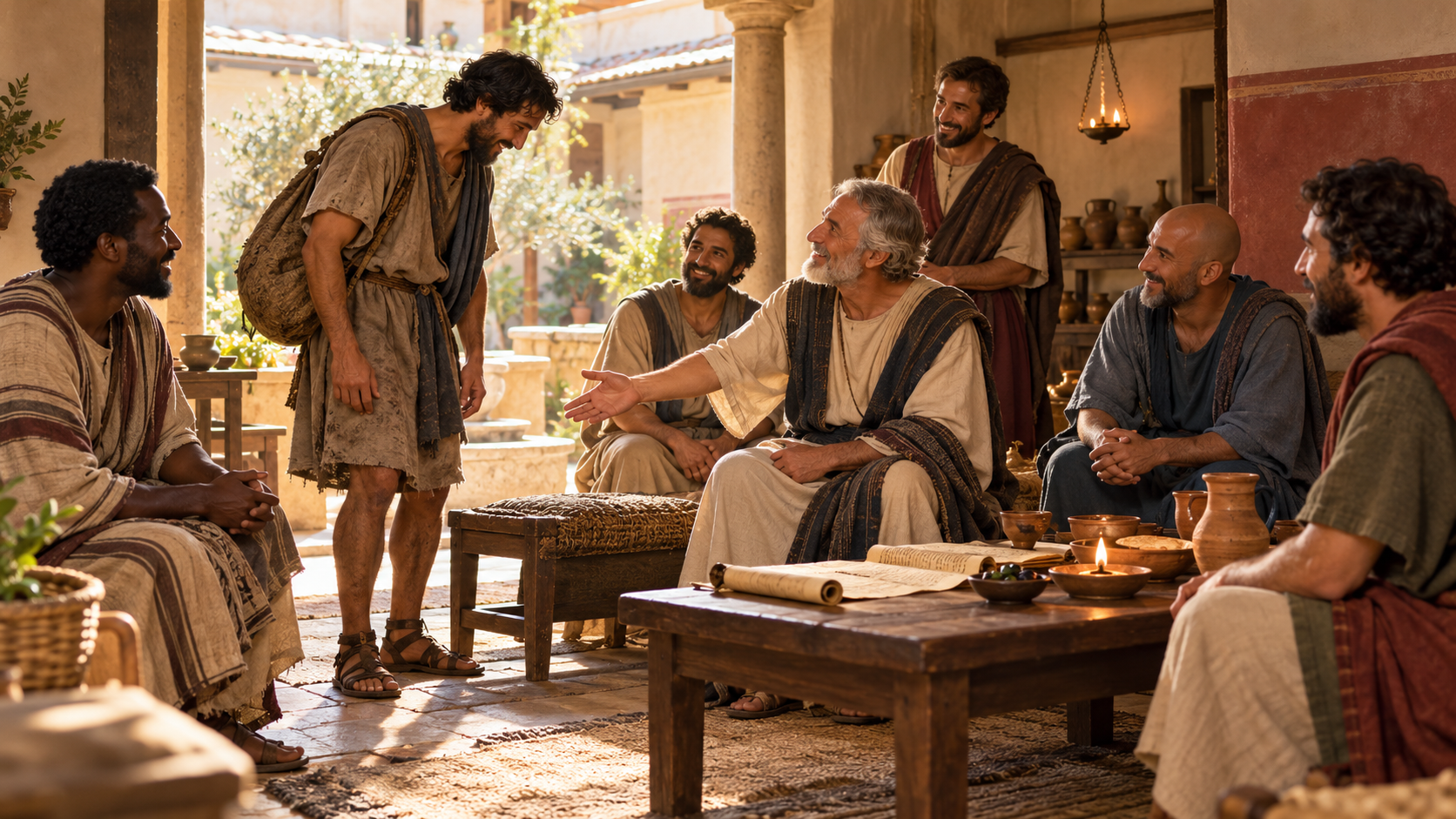
A man can work beside people every day, attend church every week, and still keep everyone at a careful distance. We often protect ourselves by staying useful, joking around, or competing quietly for respect. Paul describes another way of living: a family shaped by Christ, where affection is sincere and honor is freely given. Romans 12:10 invites us to notice the men God has placed around us, value their faithfulness, and make room for relationships strong enough to carry encouragement, correction, grief, and joy.
Scripture Explained
A room can be full of men and still feel lonely. Conversation stays on work, sports, or the latest problem because deeper affection feels awkward, and giving another man honor feels risky when we are unsure of our own place. Paul addresses this guarded instinct with a brief command that belongs inside a much larger picture of life reshaped by the mercy of God.
Romans 12 begins after eleven chapters explaining God's saving work in Christ. Paul urges believers to offer their whole lives to God, think soberly about themselves, and use their gifts as members of one body. Verse 9 then introduces love in action. The commands that follow are not techniques for becoming impressive people. They describe how people who have received mercy learn to treat one another.
The language in verse 10 carries the warmth of family affection. Paul wrote to believers in Rome, most of whom he had not yet met. Romans 16 points to several households and gathered groups rather than one church building. Jewish and Gentile believers shared this life together, and later chapters show why humility across real differences mattered. Honoring someone above yourself does not require pretending he is flawless or denying your own responsibilities. It means refusing to make your importance the measure of every relationship. Christian honor notices another person's God-given worth and gladly treats his good as significant.
Think About This
Quiet competition slips easily into male relationships. We compare income, competence, influence, physical strength, spiritual knowledge, or the apparent success of our families. Even encouragement becomes difficult when another man's progress awakens our insecurity. Paul does not answer this pressure by telling us to think poorly of ourselves. He directs our attention outward, where love is free to celebrate grace in someone else without treating his strength as a threat.
Devotion also asks more of us than compliments. A devoted brother remembers what another man is carrying, stays present after a failure, and tells the truth when silence would be easier. Honor does not excuse sin or avoid a needed correction. It shapes the way correction is given, with humility and a desire for restoration rather than the satisfaction of winning. The question is not whether another man has earned perfect treatment. What matters is whether Christ's mercy is shaping ours.
What Should I Do
Begin with one specific act of honor. Tell a coworker exactly what he contributed, thank a church volunteer whose service usually goes unnoticed, or speak well of a friend when he is not in the room. Keep the words honest and concrete. General praise fades quickly, but naming patience, courage, craftsmanship, or quiet faithfulness helps a man recognize the grace God is growing in his life.
Make room for devotion in your schedule. Send the message you have postponed, invite a brother to coffee, or ask a second question when his first answer sounds rehearsed. Friendship deepens through repeated presence, not one dramatic conversation. If you are usually the helper, practice receiving care as well. Allowing another man to pray for you or carry part of a burden honors the gifts God has placed in him.
Watch how you respond when another man succeeds. Resist the urge to redirect the conversation toward your own experience or add a criticism that reduces his achievement. Celebrate what is good, then ask how you can support his next faithful step. At home, let your family hear you honor trustworthy men rather than tearing people down for entertainment. In church, choose one relationship where you will pursue both warmth and truth over the coming month.
Learn More
Read Romans 12:1–21 as one connected appeal. Notice how worship, humility, spiritual gifts, sincere love, hospitality, patience, and peace belong together. Verse 10 is not a detached rule about good manners. It grows from a life offered to God and from the recognition that believers belong to one another. Ask where self-protection or rivalry keeps you from living as part of that body.
First Thessalonians 4:9–10 also speaks of believers being taught by God to love one another, while Philippians 2:3–8 grounds humble concern for others in the mind of Christ. John 13:34–35 shows why this matters beyond personal friendship: love among Jesus' disciples makes His work visible. These passages deepen Paul's command without turning friendship into an idol. Christ remains the center, and our devotion to one another becomes a grateful response to His devotion to us.




A Prayer to Honor My Brothers
Father, thank You for bringing me into a family through Jesus Christ. Forgive me for the ways pride, comparison, or self-protection have kept other men at a distance. Teach me to recognize Your grace in them and to give honest honor without needing attention for myself.
Lord Jesus, make me a loyal and truthful brother. Help me stay present when a man is struggling, celebrate him when he succeeds, and speak with humility when correction is needed. Use my words, time, and actions to strengthen the men You have placed around me. Amen.

The Company We Keep: In Search of Biblical Friendship by Jonathan Holmes (2014 Cruciform Press paperback)
Jonathan Holmes gives a clear, practical picture of friendship shaped by Jesus rather than convenience or shared interests. He examines the purpose, marks, and common threats of biblical friendship, then helps readers pursue relationships marked by honesty, constancy, care, and wise counsel. Its focused treatment of Christ-centered friendship makes it a close companion to Romans 12:10 and a useful book to read with another man.
1936760959





Copyright Notice
Copyright © 2026 Men Building Faith. All rights reserved.
All content on this website, including text, articles, devotionals, blog posts, graphics, logos, designs, photographs, videos, downloads, and other original materials (collectively, “Content”), is owned by Men Building Faith and is protected by U.S. and international copyright laws.
No part of this site may be copied, reproduced, republished, uploaded, posted, publicly displayed, transmitted, distributed, sold, licensed, or otherwise exploited for any purpose without prior written permission from Men Building Faith, except for brief quotations used for noncommercial purposes with proper attribution and a link back to the original page.
NLT- Scripture quotations marked (NLT) are taken from the Holy Bible, New Living Translation, copyright ©1996, 2004, 2015 by Tyndale House Foundation. Used by permission of Tyndale House Publishers, Carol Stream, Illinois 60188. All rights reserved.
NIV- Scripture quotations taken from The Holy Bible, New International Version® NIV® Copyright © 1973, 1978, 1984, 2011 by Biblica, Inc. Used with permission. All rights reserved worldwide.
AMP- Scripture quotations taken from the Amplified® Bible (AMP), Copyright © 2015 by The Lockman Foundation. Used by permission
NKJV- Scripture taken from the New King James Version®. Copyright © 1982 by Thomas Nelson. Used by permission. All rights reserved
ESV- Scripture quotations are from the ESV® Bible (The Holy Bible, English Standard Version®), copyright © 2001 by Crossway Bibles, a publishing ministry of Good News Publishers. Used by permission. All rights reserved.