
Dependence, Trust, Loyalty, Surrender, Assurance, Faith, Stability, Clarity
John 6:68 ESV
Simon Peter answered him, “Lord, to whom shall we go? You have the words of eternal life.”

Trust becomes clearest when alternatives fall apart. Options narrow. Confidence in self fades. What once felt dependable no longer holds weight. This moment captures what remains when everything else proves insufficient. It speaks to the man who realizes trust in Jesus is not one option among many, but the only place life truly holds together.
These words are spoken by Peter during a critical turning point in Jesus’ ministry, recorded by John near the end of the first century. Jesus had just delivered difficult teaching about Himself as the bread of life, language many followers found offensive and confusing. Large crowds who once followed Him for signs and provision began to leave. What remained was not popularity, but decision.
Peter’s response reveals the core of true faith. He does not claim full understanding. He does not defend the teaching. He acknowledges reality. There is nowhere else to go. Jesus alone speaks life that reaches beyond circumstance and mortality. Trust is rooted not in comfort, but in truth. God’s provision is not always explained, but it is always sufficient.
This truth presses into moments when belief feels costly. When obedience isolates. When following Jesus means releasing backup plans and false securities. Trusting completely means recognizing that walking away offers no real alternative. Life apart from Christ may promise relief, but it cannot sustain the soul. Confidence settles when trust stops searching for replacements.
The crowd thins. Silence replaces excitement. A small group remains standing in front of Jesus, aware that following Him may lead into uncertainty rather than ease. Peter speaks not out of certainty, but commitment. Trust anchors itself not in outcomes, but in relationship.
The chapter unfolds with increasing contrast between shallow belief and enduring faith. Reading it in full reveals why trust in Jesus must move beyond convenience and into conviction.
This statement from Peter comes at one of the most revealing moments in the Gospels. It is not spoken during a miracle, a victory, or a season of growth. It is spoken when faith is thinning out, expectations are collapsing, and following Jesus has become uncomfortable.
HISTORICAL AND LITERARY CONTEXT
John 6 records a dramatic rise and fall in Jesus’ public following. The chapter begins with the feeding of the five thousand, one of the few miracles recorded in all four Gospels. Crowds follow Jesus eagerly because He meets a physical need. They want more provision. Some even want to make Him king by force.
Jesus withdraws, then later confronts the crowd with teaching that shifts the focus from bread to belief, from provision to personhood. He declares Himself to be the Bread of Life. He speaks of coming down from heaven. He insists that eternal life is found only in Him.
This teaching offends many. John 6:60 states that many disciples said, “This is a hard saying; who can listen to it?” By verse 66, John records a turning point: many of His disciples turned back and no longer walked with Him.
This is the setting for Peter’s statement. Jesus turns to the Twelve and asks a direct question: “Do you want to go away as well?” Peter’s response is not rehearsed theology. It is a moment of raw allegiance.
THE SIGNIFICANCE OF PETER’S WORDS
Peter says, “Lord, to whom shall we go? You have the words of eternal life.”
This is not a declaration of full understanding. Peter does not say he grasps everything Jesus has taught. He does not say the teaching makes sense or feels comfortable. What he acknowledges is exclusivity. There is no alternative source of life.
The structure of the sentence matters. The emphasis falls on “to whom.” Peter does not ask where else to go, but who else to trust. Eternal life is not a concept or a system. It is tied to a person.
THEOLOGICAL MEANING
In John’s Gospel, “life” is a central theme. The Greek word used here is zōē (ζωή), which refers not merely to physical existence, but to life as God intends it. This is eternal life that begins now and continues beyond death.
Peter recognizes that Jesus does not merely speak about life. He carries it. His words do not inform only. They impart. This aligns with earlier statements in John’s Gospel:
John 1:4
In Him was life, and the life was the light of men.
John 5:24
Whoever hears My word and believes Him who sent Me has eternal life.
Peter’s confession is grounded in this reality. Trust in Jesus is not based on outcomes, popularity, or clarity. It is based on identity. Jesus alone possesses and communicates eternal life.
COMPLETE TRUST WITHOUT BACKUP OPTIONS
Peter’s statement exposes a key aspect of genuine faith. True trust is revealed when alternatives disappear. Many followed Jesus as long as He met expectations. When His teaching challenged comfort, they left.
Peter stays, not because staying feels safe, but because leaving offers nothing better.
This moment defines biblical faith. Trust is not clinging to Jesus while quietly preparing an exit strategy. It is the recognition that life apart from Him is no life at all.
This aligns with Jesus’ later teaching in John 15:5
Apart from Me you can do nothing.
It also echoes Old Testament language of exclusive reliance on God:
Psalm 73:25
Whom have I in heaven but You? And there is nothing on earth I desire besides You.
Peter’s words reflect this same posture. Trust is complete because there is no substitute.
PASTORAL APPLICATION FOR TODAY
This verse speaks powerfully to seasons where faith feels costly.
When prayer feels unanswered.
When obedience isolates.
When trusting Jesus leads to loss rather than ease.
In those moments, the question surfaces again: where else would you go?
Trusting completely in Jesus means releasing the demand for immediate clarity. It means remaining even when faith no longer feels reinforced by emotion or outcome.
This does not minimize struggle. Peter himself would later fail, deny Jesus, and wrestle with fear. Yet the foundation of his trust was already set here. He knew there was nowhere else that offered life.
CHAPTER-LEVEL CONNECTION
John 6 contrasts two types of belief:
• Belief rooted in provision and signs
• Belief rooted in personhood and truth
Those who followed Jesus for bread walked away when the cost rose. Those who remained trusted Him beyond understanding.
This chapter prepares the reader for the rest of the Gospel, where belief will increasingly require surrender rather than reward.
Peter’s statement becomes a hinge point. From this moment forward, the disciples follow Jesus not because the crowds are large, but because their trust has deepened.
CROSS-REFERENCES FOR FURTHER STUDY
John 14:6
Jesus as the exclusive way to the Father
Acts 4:12
No other name under heaven by which we must be saved
Hebrews 6:19
Hope as an anchor for the soul
Isaiah 55:2–3
Listening to the voice that gives life
RELIABLE STUDY LINKS
Wikipedia – John 6
https://en.wikipedia.org/wiki/John_6
Bible Gateway – John 6 (ESV)
https://www.biblegateway.com/passage/?search=John%206&version=ESV
Enduring Word Commentary – John 6
https://enduringword.com/bible-commentary/john-6/
Greek Lexicon – zōē (life)
https://www.blueletterbible.org/lexicon/g2222/esv/tr/0-1/
Greek Lexicon – logos (word)
https://www.blueletterbible.org/lexicon/g3056/esv/tr/0-1/
CLOSING TEACHING SUMMARY
Peter’s confession is not emotional. It is decisive.
Faith that endures does not rest on what Jesus provides, but on who He is. When everything else falls away, trust remains because nothing else holds life.
Complete trust in Jesus is not the absence of doubt. It is the refusal to walk away.
There is nowhere else to go.



Choosing Trust Without Backup Plans
Jesus, I admit how often I look for security outside of You. When answers delay and paths narrow, I am tempted to search for control rather than trust. Peter’s words confront that instinct. There is nowhere else that offers life the way You do. Help me stop treating trust as conditional and start living it as complete dependence.
Teach me to remain when following You feels uncertain or costly. When understanding falls short and outcomes remain unclear, anchor my confidence in who You are rather than what I expect. I want my faith to rest fully in You, without escape routes or divided loyalty. Shape my heart to trust You completely, knowing You alone hold the words of eternal life.
In Jesus’ name, Amen.
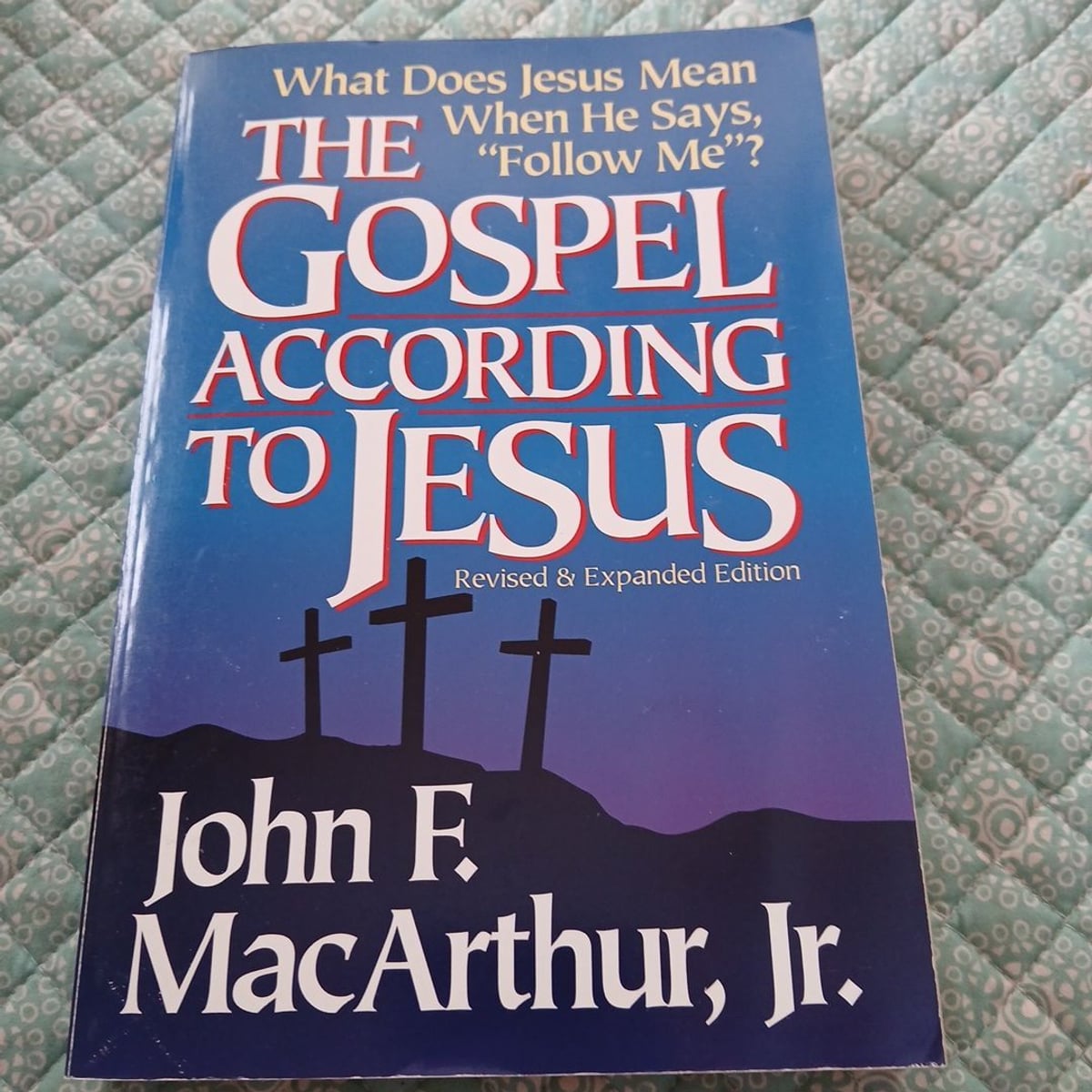
The Gospel According to Jesus: What Is Authentic Faith?
John MacArthur examines what Jesus meant when He called people to follow Him. The book challenges shallow belief and explains the life-changing nature of genuine faith. It supports this verse by directing the reader back to Jesus as the source of truth, life, and genuine discipleship.
0310291364

Copyright Notice
Copyright © 2026 Men Building Faith. All rights reserved.
All content on this website, including text, articles, devotionals, blog posts, graphics, logos, designs, photographs, videos, downloads, and other original materials (collectively, “Content”), is owned by Men Building Faith and is protected by U.S. and international copyright laws.
No part of this site may be copied, reproduced, republished, uploaded, posted, publicly displayed, transmitted, distributed, sold, licensed, or otherwise exploited for any purpose without prior written permission from Men Building Faith, except for brief quotations used for noncommercial purposes with proper attribution and a link back to the original page.
NLT- Scripture quotations marked (NLT) are taken from the Holy Bible, New Living Translation, copyright ©1996, 2004, 2015 by Tyndale House Foundation. Used by permission of Tyndale House Publishers, Carol Stream, Illinois 60188. All rights reserved.
NIV- Scripture quotations taken from The Holy Bible, New International Version® NIV® Copyright © 1973, 1978, 1984, 2011 by Biblica, Inc. Used with permission. All rights reserved worldwide.
AMP- Scripture quotations taken from the Amplified® Bible (AMP), Copyright © 2015 by The Lockman Foundation. Used by permission
NKJV- Scripture taken from the New King James Version®. Copyright © 1982 by Thomas Nelson. Used by permission. All rights reserved
ESV- Scripture quotations are from the ESV® Bible (The Holy Bible, English Standard Version®), copyright © 2001 by Crossway Bibles, a publishing ministry of Good News Publishers. Used by permission. All rights reserved.