
Uncertain, Pressured, Responsible, Seeking, Dependent, Hopeful, Surrendered, Focused, Led, Courageous
Proverbs 3:5–6 AMP
Trust in and rely confidently on the Lord with all your heart And do not rely on your own insight or understanding. In all your ways know and acknowledge and recognize Him, And He will make your paths straight and smooth [removing obstacles that block your way].

There is a point where a man has gathered all the facts, heard every opinion, and still has to decide. That is where this proverb speaks. Hard decisions expose how much you really trust your own insight versus how much you trust God to lead you. You can keep hunting for one more angle, one more guarantee, or you can decide whose hands your path is actually in. These lines reach into that moment and call you to lean the full weight of your heart on the Lord, not just nod to Him while still clinging to control. They are written for the man who is tired of carrying every outcome alone and is ready to let God straighten what he cannot.
Proverbs gathers wise sayings for real life, rooted in the fear of the Lord as the starting point of knowledge. Chapter 3 reads like a father speaking to his son, urging him to remember teaching, keep commands, and anchor his life in loyalty and truth. These verses, 5 and 6, sit near the front of the chapter as a core posture that shapes everything else. They are not about avoiding hard decisions, but about how to move through them without being ruled by your own limited understanding. In a world where alliances, trade, and daily survival required countless choices, trusting Yahweh fully was not a slogan. It was a way of walking.
The verses reveal a God who invites both confidence and surrender. “Trust in and rely confidently on the Lord with all your heart” calls for more than a surface belief. It asks for the whole inner life to lean on Him. “Do not rely on your own insight or understanding” does not mean you stop thinking. It means you do not treat your perception as final. “In all your ways know and acknowledge and recognize Him” pushes this beyond big moments into daily patterns: inviting God into the way you plan, speak, spend, respond, and lead. The promise follows: “He will make your paths straight and smooth.” The straight path is not always the easiest path, but it is the one cleared and guided by His hand.
For a man today, these lines confront the instinct to trust spreadsheets, instincts, and emotions more than the Lord who sees the whole road. You are called to do your homework, seek counsel, and weigh options, but not to treat any of that as higher than knowing and acknowledging Him. This shows up when you decide where to work, how to lead your home, whether to say yes to another responsibility, or how to navigate conflict. The call is to let God’s character, Word, and presence become the reference point, not just an afterthought.
Think of a person who sits in his truck outside a meeting that could change his career path, the numbers and risks already running through his mind. The plan in his hand makes sense on paper, but something in him knows there is more at stake than income and status. Before stepping out, he rests his head back, takes a slow breath, and prays, “Lord, I am choosing to trust You, not just my read on this. Show me where You are in this path.” The meeting still requires clarity and courage, but he walks in as a man leaning on God, not only on himself.
The rest of Proverbs 3 continues to flesh out what this trust looks like: honoring God with resources, accepting His discipline, valuing wisdom above wealth, and resisting the pull of envy and fear. Reading the chapter around these verses lets you see how trusting in the Lord with all your heart plays out across an entire life, not only in isolated decisions.
THE DEEPER DIVE
Proverbs sits in Israel’s wisdom tradition, where the fear of the Lord is the beginning of knowledge and wise living is the main goal. Chapter 3 reads like a father instructing his son, urging him to remember teaching, obey commands, and build his life on loyalty and truth rather than on appearances or quick gain. Verses 5 and 6 land at the heart of that instruction. They are not advice for a peaceful afternoon; they are a pattern for living when choices are high-stakes and the outcome is uncertain. The Amplified wording pulls out the layers: “trust in and rely confidently,” “with all your heart,” “do not rely,” “in all your ways know and acknowledge and recognize Him,” “He will make your paths straight and smooth.” Every phrase pushes against the instinct to split life into “God’s part” and “my part” and instead calls for a whole-life posture.
In the original Hebrew, the word for “trust” carries the idea of leaning hard on something, putting your weight on it. Trust here is not a vague feeling. It is the decision to put the weight of your heart and direction on the Lord, not on your analysis alone. “Heart” in biblical language includes mind, will, and affections. “All your heart” means nothing is held back: no hidden reserve where you still insist on having the final say. “Do not rely on your own understanding” recognizes that your perspective is limited and often distorted by fear, pride, or desire. The goal is not to stop thinking, but to stop treating your thinking as the highest authority. “In all your ways know and acknowledge and recognize Him” stretches this beyond big crisis moments into the daily paths: work habits, conversations, money decisions, plans for the future. The promise that He will make your paths straight and smooth does not mean no difficulty; it means He will direct and clear the path that aligns with His will, turning a maze into a road you can walk.
WHAT PROVERBS 3:5–6 SHOWS ABOUT GOD’S CALL
Proverbs 3:5–6 shows that God’s call on a man is first about who he leans on, not how clever he is. God calls you to trust and rely confidently on Him with all your heart. That call cuts across a culture that praises self-reliance and image management. God is not asking for a half-hearted nod while you secretly keep control. He is calling for a shift of weight: from your own insight to His character and guidance. The Amplified’s “know and acknowledge and recognize Him” shows that God’s call is not just to know facts about Him, but to actively bring Him into every path you walk.
The promise that He will make your paths straight and smooth reveals that God’s call includes direction. He is not only watching from a distance while you try to guess the right moves. He is involved in the shaping of your road. His call is to walk with Him, not ahead of Him. That means your job is not to see the entire map, but to trust His hand with the next step. This verse shows that God’s call on you is not to be the hero of your story, but to be the man who trusts the One who already knows the story’s end.
HOW PROVERBS 3:5–6 FLOWS
These verses sit inside a larger flow in Proverbs 3:
Verses 1–4: A father urges his son not to forget his teaching and to keep commandments in his heart. The result is long life, peace, and favor with God and people.
Verses 5–6: He then gives the central posture: trust in the Lord with all your heart, do not lean on your own understanding, acknowledge Him in all your ways, and He will make your paths straight.
Verses 7–10: The application follows: do not be wise in your own eyes, fear the Lord and turn from evil, honor the Lord with your wealth, and your barns will be filled.
Verses 11–12: He talks about not despising the Lord’s discipline, because the Lord disciplines the one He loves.
Seen in that flow, Proverbs 3:5–6 is the hinge. The call to trust God with all your heart and to acknowledge Him in all your ways undergirds the later commands to reject self-made wisdom, to submit to discipline, and to honor God with money and resources. It connects the inner posture (trust) with the outer actions (obedience, generosity, humility). When the father speaks about straight paths, he is preparing his son for the reality that life will offer many crossroads. The straight path is not random; it belongs to the man who has chosen the posture of trust and recognition of God in everything.
WORD AND PHRASE STUDY (PLAIN-LANGUAGE FOCUS)
A few key ideas in these verses:
“Trust in and rely confidently” – Trust is leaning your full weight on something. “Rely confidently” adds the sense of settled expectation, not a tentative experiment.
“With all your heart” – Heart includes thinking, choosing, and feeling. All your heart means there is no hidden corner where you still insist on calling all the shots.
“Do not rely on your own insight or understanding” – Your understanding includes your analysis, experience, and intuition. The verse does not tell you to ignore them, but to refuse to treat them as final and unquestionable.
“In all your ways know and acknowledge and recognize Him” – “Ways” are your paths, patterns, and habits. Knowing, acknowledging, and recognizing God means bringing Him into the conversation about every area, not just spiritual activities. It includes prayer, checking your motives against His Word, and being ready to adjust when He redirects.
“He will make your paths straight and smooth” – Straight paths are directed and purposeful, not crooked or deceptive. Smooth, as the Amplified explains, points to God’s work in removing obstacles that would block His will, not necessarily every difficulty you do not like.
Put together, the verse describes a man who thinks, plans, and acts, but does so with his weight on God’s wisdom and with his ways open before God, trusting that God will shape the road.
IMPLICATIONS FOR IDENTITY, CALLING, AND RISK
Identity: This passage tells you that being a godly man is not about never needing help. It is about being the man who does not pretend his own understanding is enough. Your identity is not “the guy who always knows what to do,” but “the man who knows whom to trust.” That frees you from the pressure to be the self-made expert in every situation.
Calling: You are called to live in a way where every category of your life is open to God’s direction. That includes money, career moves, friendships, ministry commitments, how you handle conflict, and how you lead at home. “In all your ways” leaves no category blocked off. Your calling is not only to ask God to rescue you when plans fail, but to know, acknowledge, and recognize Him while you are forming those plans.
Risk: Trusting God more than your own understanding will sometimes mean choosing a path that looks less secure, less prestigious, or less immediately profitable. It might mean staying when it would be easier to run, or leaving when staying would keep you comfortable. Proverbs 3:5–6 does not promise that the straight path will be the most comfortable, but it does promise that it will be the one God is in. The risk is real, but so is His guidance.
HOW THIS SHOWS UP IN ORDINARY DECISIONS
You see Proverbs 3:5–6 in action when you stop before a decision and genuinely ask, “What would it look like to acknowledge God here” Before signing a contract, you think beyond the money and ask whether this move lines up with God’s priorities for your family, your integrity, and your time. When a conflict flares up, instead of trusting your impulse to win the argument, you remember God’s call to be slow to anger and to pursue peace, and you adjust your tone and timing.
It shows up when you budget. Instead of assuming every dollar is yours to deploy according to your desires, you treat your resources as belonging to the Lord. You trust Him enough to give, to save wisely, and to say no to certain purchases, even if your understanding says, “I can make this work.” You are acknowledging Him in your ways, not just asking Him to bless what you have already decided.
It shows up in leadership moments. You may have a strong sense of what would make you look good or keep people happy. Trusting God with all your heart means you are willing to obey what you see in His Word and sense from His Spirit, even if it means a harder conversation, a slower growth path, or letting go of something that feeds your ego.
CONNECTION TO PROVERBS AND THE REST OF SCRIPTURE
Proverbs regularly warns against being “wise in your own eyes” and praises those who listen to counsel and fear the Lord. Proverbs 3:5–6 fits that pattern. It bridges the internal posture of trust with the external life of wisdom. Later in the chapter, honoring the Lord with your wealth, accepting His discipline, and valuing wisdom above silver and gold all flow from this same trust posture.
Across Scripture, you see the same theme. In Isaiah, God calls His people away from trusting in horses, chariots, or foreign alliances and back to trusting Him. In the Gospels, Jesus calls disciples to follow Him, not their own plans, even when it means leaving nets, tax booths, or crowds. In the letters, Paul warns against leaning on human wisdom that leaves God out and points believers back to Christ as the wisdom of God. Proverbs 3:5–6 lines up with all of this: trust the Lord fully, refuse to worship your own understanding, and bring Him into all your ways.
PRACTICAL QUESTIONS FOR SELF-EXAMINATION
Where in my life am I clearly leaning on my own understanding more than on the Lord’s character and Word
Are there any areas (money, work, relationships, plans) where I rarely, if ever, actively acknowledge God before deciding
When I face a crossroad, do I mainly ask, “What do I want and what makes sense to me,” or do I ask, “What would it look like to trust and obey God here”
Have I ever used “wisdom” as a cover for fear or self-protection, instead of stepping into what I know God is asking me to do
What would change, practically, if I began to pause and pray Proverbs 3:5–6 over specific decisions this week
Letting those questions sit with you in prayer, and maybe talking them through with trusted brothers, can start to reset how you approach both big and small decisions.
HELPFUL RESOURCES FOR DEEPER STUDY
Proverbs 3 text in multiple translations with tools
https://biblehub.com/proverbs/3-5.htm
Proverbs 3 – AMP text and study notes
https://www.biblegateway.com/passage/?search=Proverbs%203&version=AMP
Overview and structure of the book of Proverbs
https://en.wikipedia.org/wiki/Book_of_Proverbs
Commentary on Proverbs 3 with historical and practical insights
https://enduringword.com/bible-commentary/proverbs-3/
Article-style teaching on trusting God from Proverbs 3:5–6
https://www.christianity.com/bible/commentary/matthew-henry-complete/proverbs/3.html



Trusting God More Than My Own Insight
Lord, You see how quickly I run to my own insight when decisions get heavy, and how easily I treat my understanding as the final word, so today I choose to admit that I do not see the whole road and I need You to lead me. You tell me to trust in and rely confidently on You with all my heart, not just the parts that feel spiritual or safe, and I confess that I often keep one hand on the wheel while saying I trust You; I calculate, I worry, I overthink, and I chase control. I am bringing You the paths in front of me, the ones that affect my work, my family, my money, and my ministry, and I am asking You to help me know, acknowledge, and recognize You in all of them. Where my motives are mixed, purify them. Where fear is driving me, calm it. Where pride is pushing me to prove something, bring it low. I ask You to make my paths straight and smooth in the way that matters most: not by removing every difficulty, but by clearing what would pull me away from Your will. Teach me to seek Your voice in Scripture, to listen when wise counsel speaks, and to pay attention when Your Spirit checks my heart. I do not want to lean on my own understanding and then ask You to bless it after the fact; I want to walk with You in the decision itself. Give me the courage to obey what You show me, even when it costs me comfort or approval, and let my trust in You be visible in how I lead, how I wait, and how I move forward. In Jesus’ name, Amen.
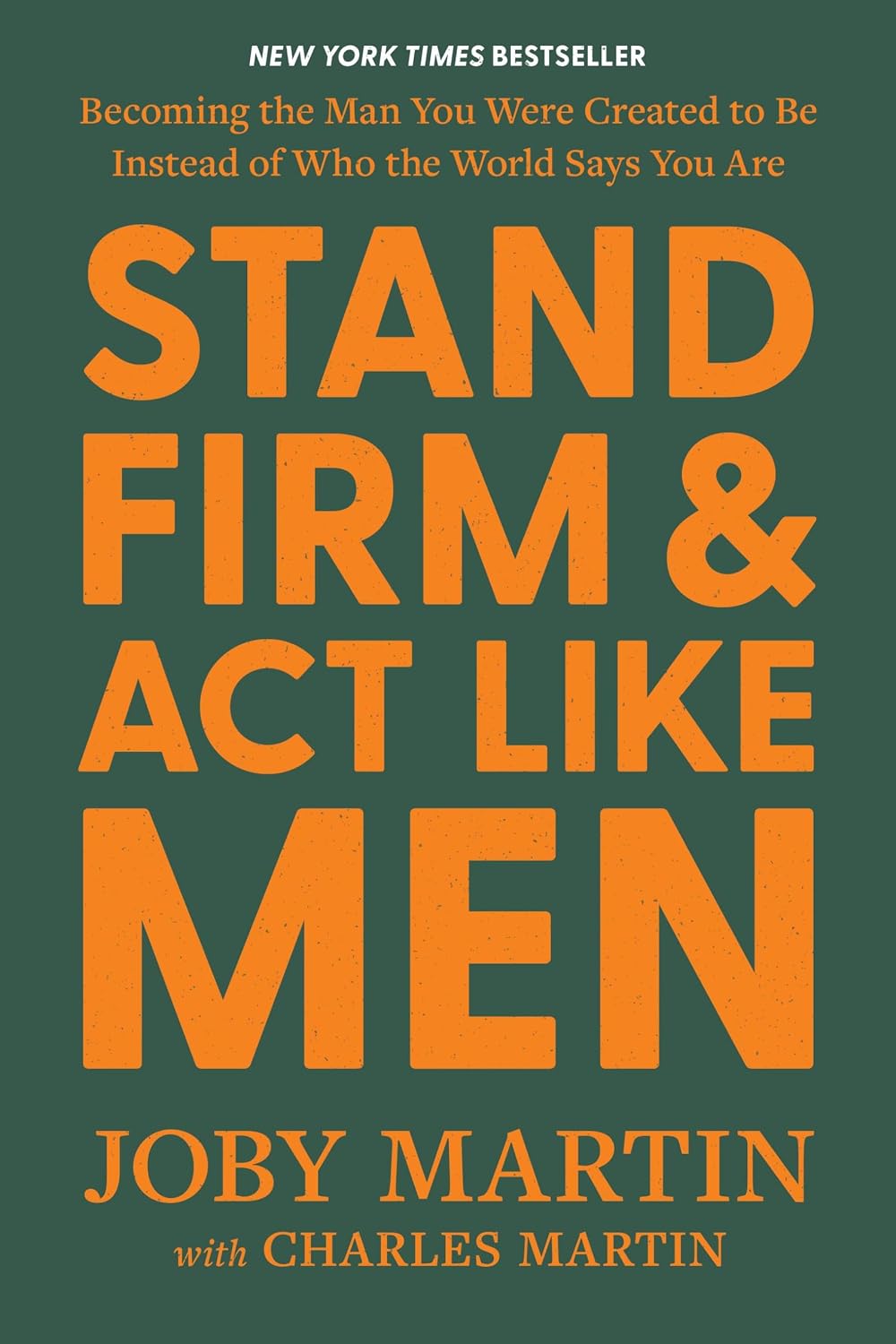
Stand Firm and Act Like Men: Becoming the Man You Were Created to Be Instead of Who the World Says You Are
Joby Martin gives men a direct biblical challenge to live with courage, responsibility, humility, and conviction in a culture filled with conflicting messages. It encourages men to trust God's direction instead of leaning entirely on their own judgment.
1546008217


Copyright Notice
Copyright © 2026 Men Building Faith. All rights reserved.
All content on this website, including text, articles, devotionals, blog posts, graphics, logos, designs, photographs, videos, downloads, and other original materials (collectively, “Content”), is owned by Men Building Faith and is protected by U.S. and international copyright laws.
No part of this site may be copied, reproduced, republished, uploaded, posted, publicly displayed, transmitted, distributed, sold, licensed, or otherwise exploited for any purpose without prior written permission from Men Building Faith, except for brief quotations used for noncommercial purposes with proper attribution and a link back to the original page.
NLT- Scripture quotations marked (NLT) are taken from the Holy Bible, New Living Translation, copyright ©1996, 2004, 2015 by Tyndale House Foundation. Used by permission of Tyndale House Publishers, Carol Stream, Illinois 60188. All rights reserved.
NIV- Scripture quotations taken from The Holy Bible, New International Version® NIV® Copyright © 1973, 1978, 1984, 2011 by Biblica, Inc. Used with permission. All rights reserved worldwide.
AMP- Scripture quotations taken from the Amplified® Bible (AMP), Copyright © 2015 by The Lockman Foundation. Used by permission
NKJV- Scripture taken from the New King James Version®. Copyright © 1982 by Thomas Nelson. Used by permission. All rights reserved
ESV- Scripture quotations are from the ESV® Bible (The Holy Bible, English Standard Version®), copyright © 2001 by Crossway Bibles, a publishing ministry of Good News Publishers. Used by permission. All rights reserved.